The $500 Barrier Wasn't Lowered. It Was Demolished.
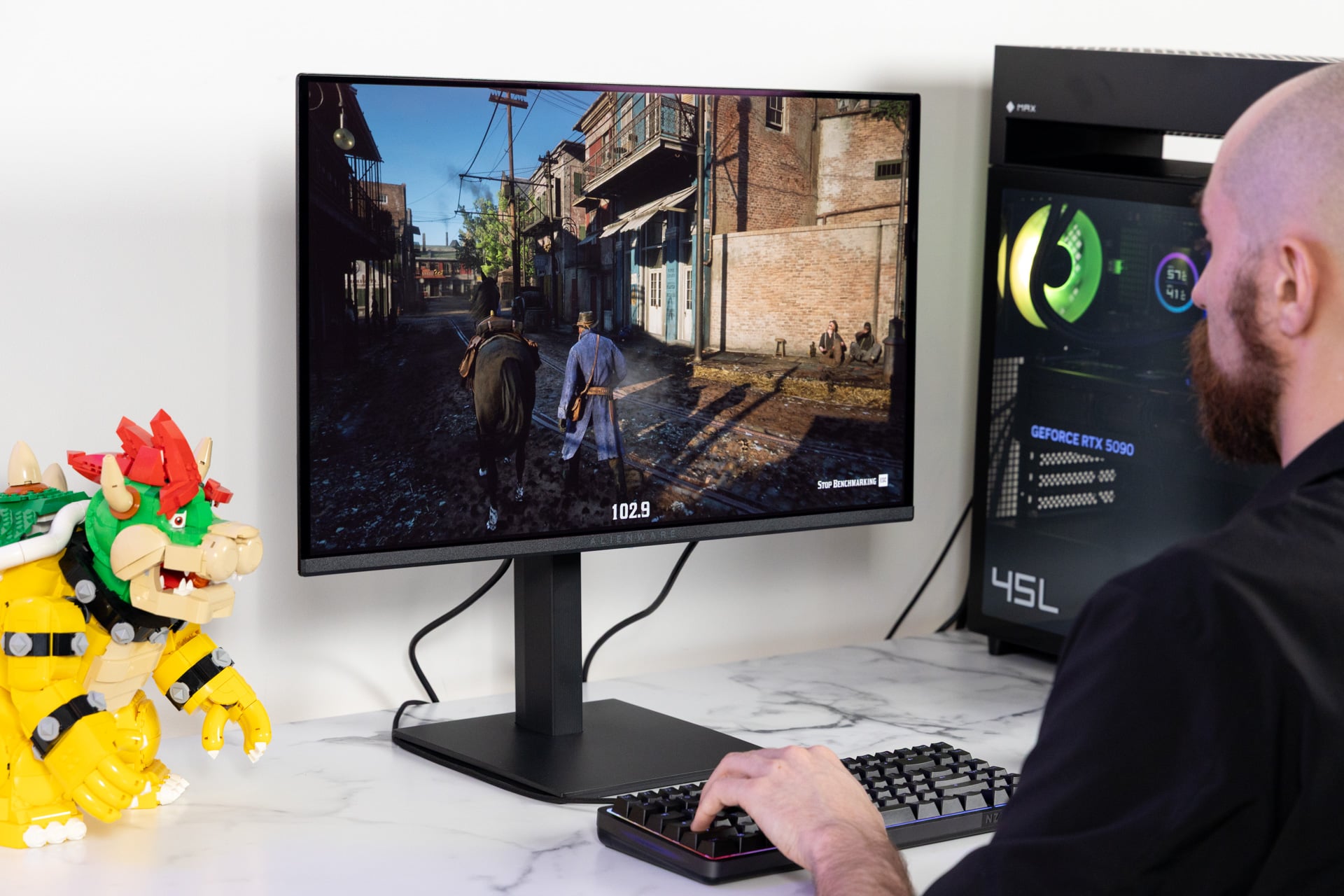
I've been waiting for this moment since the first Samsung QD-OLED panel shipped in 2022, and I want to be precise about what just happened. Dell's new Alienware AW2726DM — a 27-inch 2560x1440 240Hz QD-OLED — retails at $349.99. Not a flash sale. Not a rebate. That's the sticker. For context, the structurally identical AW2725DF launched at $899 roughly 18 months ago. We just watched a QD-OLED lose 60% of its MSRP in a year and a half, and the panel itself didn't get worse.
The Numbers That Actually Matter
Let me cut through the marketing. Tom's Hardware's review pegs the post-calibration gamut volume at 111% of DCI-P3, with a native 10-bit panel driving over a billion distinct color states. Response time is the standard QD-OLED 0.03ms — effectively instantaneous pixel transitions, no overdrive artifacts, no inverse ghosting to tune out. Black level is whatever your room's ambient light allows you to perceive, because the emissive pixels genuinely shut off. Contrast ratio is unmeasurable in the conventional sense. If your measurement gear returns a number, it's noise floor.
HDR peak tops out around 1,000 nits on a 3% window, which is in line with every other 4th-gen QD-OLED on the market. Where the AW2726DM diverges from its more expensive siblings is full-screen SDR brightness: 200 nits rated, ~185 measured. That's the compromise. That's the entire story behind the price.
Why 200 Nits Is — and Isn't — a Problem
Here's where I'll lose the "OLED for everything" crowd: 185 nits is fine for a light-controlled desk. It is not fine for a south-facing window at 2pm. QD-OLED's weakness has always been ambient contrast — the triangular subpixel structure reflects enough ambient light to wash out blacks in bright rooms, which is precisely why Samsung Display is pivoting its 2026 roadmap toward the new V-Stripe RGB subpixel layout. The AW2726DM is not a V-Stripe panel. It's the mature 4th-gen triangular QD-OLED, binned and priced to clear.
For text work, you will see subpixel fringing on black-on-white. It's mild, it's present, and if you've been spoiled by an IPS or the new 34" V-Stripe ultrawide, you will notice. If the colors are wrong, nothing else matters — and the colors here are excellent. But the geometry of the subpixels is still last-gen.
What You're Actually Giving Up at $349
The cut list is blunt: no USB hub, no speakers, no G-Sync module (FreeSync Premium and VESA AdaptiveSync only), and none of the AlienFX OEM software support. You configure the monitor with the rear joystick. There's one DP 1.4 and two HDMI 2.1 inputs. That's the panel, the stand, the power brick, and a 3-year burn-in warranty. Everything else was deleted to hit the price.
Calibration is the one place I'd still spend money. Factory Delta E is claimed under 2 on the preset modes, but I want to see independent colorimeter runs before I trust that across the full DCI-P3 volume. QD-OLED panels historically show higher Delta E drift in the near-black ramp — a gamma curve problem, not a gamut problem — and the budget SKU is exactly where you'd expect QC to be looser.
The Market Implication
This isn't a one-off. Samsung Display has been ramping 4th-gen QD-OLED fab capacity for three quarters while the V-Stripe 5th-gen panels steal the spotlight at CES 2026. The older panels have to go somewhere, and they're going into monitors like this one. Expect MSI, Gigabyte, and Asus to follow within 90 days with $349-$399 variants of their own 2024-era QD-OLED SKUs. LG's 480Hz WOLED has an answer at the top end, but nothing at this price point.
If you own a 2023 QD-OLED and you've been telling yourself you'll upgrade when the V-Stripe panels ship — that's still the right move. If you're coming from a TN or a bad VA and you've been priced out of OLED entirely, the AW2726DM is the cheapest competent QD-OLED on the market, and the panel genetics are solid. Just run a calibration pass before you declare victory.
Loading comments...