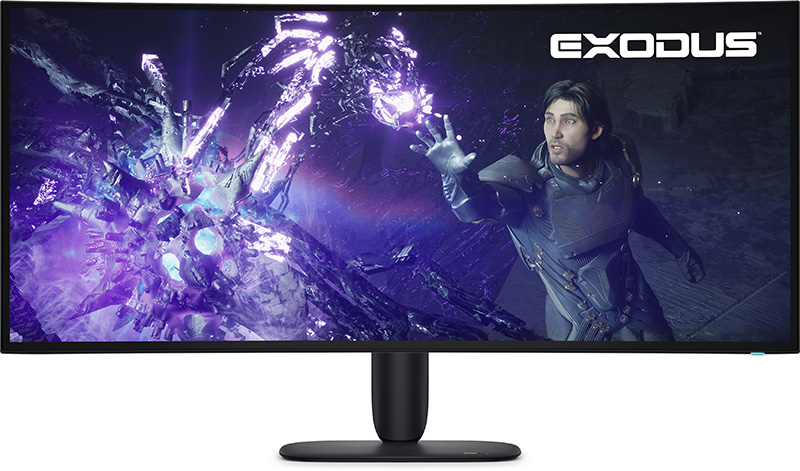
The Subpixel Wars Are Finally Over
If you've ever squinted at magenta fringing on a WOLED monitor and told yourself it was fine — it wasn't fine. And you knew it. The white subpixel that made WOLED panels bright enough to be usable also shredded every serif in every font ClearType ever tried to render. Windows was never designed for WRGB. Six years of workarounds — ClearType tweaks, MacType, third-party font rendering — none of it fixed the underlying problem: the subpixel geometry was wrong.
Dell's Alienware AW3926QW, which begins shipping globally this month at $1,099, is the first 39-inch OLED that ships with an actual RGB stripe layout. Not WRGB. Not the pentile-adjacent triangle QD-OLED uses. Real, honest-to-god red-green-blue stripes, in that order, like a proper LCD from 2010. Windows renders on this thing correctly. Chrome renders correctly. VS Code renders correctly. Every text-heavy workflow that has been a compromise on ultrawide OLED for the last three years is no longer a compromise.
What's Inside the 4th-Gen Tandem Panel
LG Display's 4th-generation Tandem WOLED architecture stacks two emissive OLED layers on top of each other, effectively doubling the light output the panel can push through the color filters without frying the organic material. On the AW3926QW, that translates to 1,300 nits peak in a 1.5% APL window and a sustained 300 nits SDR full-field — a number that still lags the best Mini-LEDs, but for OLED that's the ceiling of physically achievable brightness in 2026.
The removal of the white subpixel is the interesting engineering choice here. WOLED historically leaned on the W element for luminance headroom. Without it, LG has to compensate purely through the tandem stack, and the fact that they're still hitting 1,300 nits is a real credit to the emitter chemistry improvements in Gen 4. Delta E measures below 2 out of the factory across the DCI-P3 volume, with 99.5% coverage — the color pipeline is essentially perfect.
Glossy, Curved, and Uncompromising
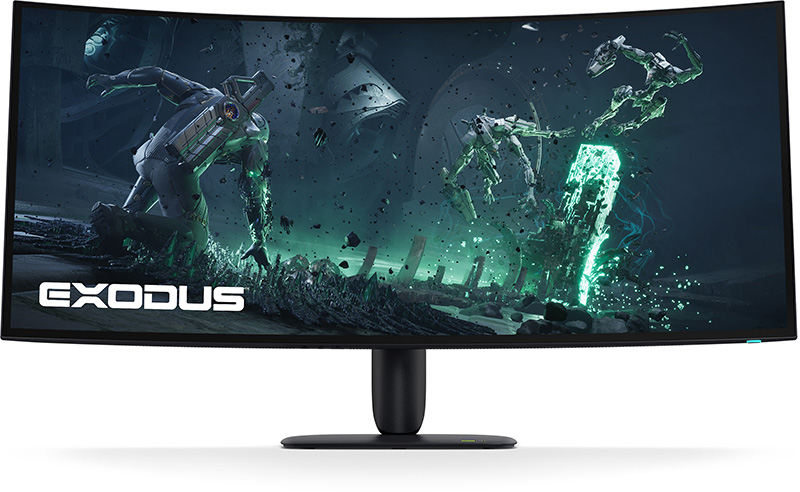
Dell went glossy on the coating, which is the correct decision and I will die on this hill. Matte anti-glare finishes on OLED panels are a crime against contrast. They scatter every specular highlight, add microscopic haze to blacks that are supposed to be infinite, and turn the deepest strength of self-emissive displays into a beige compromise. If you can't control your room lighting, buy a different monitor.
The 1500R curvature at 39 inches actually makes sense — at that width, a flat panel forces your eyes to refocus at the edges. The 5120x2160 resolution works out to roughly 140 PPI, which is well past the density where subpixel structure becomes invisible at normal viewing distances. Combined with the RGB stripe layout, text renders like a high-DPI IPS. This is the OLED-for-work monitor that a lot of us have been waiting for.
The Dual-Mode Refresh Rate Trick
165Hz at native 5K2K, or 330Hz at 2560x1080 in dual-mode. The dual-mode feature exploits the fact that at 1080p the panel only drives half its horizontal pixels, freeing enough bandwidth headroom for the pixel driver to run at double the vertical refresh. It's a genuinely clever piece of engineering — competitive shooter players get their motion clarity, productivity users get their pixel density, all on one panel.
Response time is quoted at 0.03ms G2G, which is the standard OLED number that means "faster than you can measure with anything short of a high-speed photodiode." What matters more for motion clarity is the sample-and-hold behavior, and OLED's near-instant pixel transitions eliminate the ghosting that even the fastest IPS panels still exhibit.
Connectivity Actually Keeps Up
DisplayPort 2.1 UHBR 20 is a requirement for 5K2K at 165Hz with 10-bit color and no DSC — the raw bandwidth math demands it. Dell included it. Also dual HDMI 2.1 for consoles, USB-C with 90W PD for single-cable laptop docking, and KVM switching for multi-machine desks. The port loadout is professional-grade.
The 3-year burn-in warranty is what it should be for a $1,099 OLED. Anything less would be malpractice at this price point. If you're worried about static UI elements — taskbars, IDE panels, watched HUDs — this warranty gets you covered through the panel's most vulnerable years.
Verdict Before the Verdict
The AW3926QW isn't just another OLED monitor. It's the panel geometry finally catching up to the color performance. For anyone whose workflow mixes gaming, media, and actual text — which is to say, most of us — this is the first ultrawide OLED that doesn't force you to choose between beautiful HDR and readable code. If the colors are right and the text is sharp, everything else follows.
Loading comments...