ARM Crosses the Rubicon
For decades, ARM's business model was elegant in its simplicity: design the instruction set and the core IP, license it to everyone else, and let the industry do the heavy lifting on silicon. That model built ARM into one of the most valuable semiconductor IP companies in history.
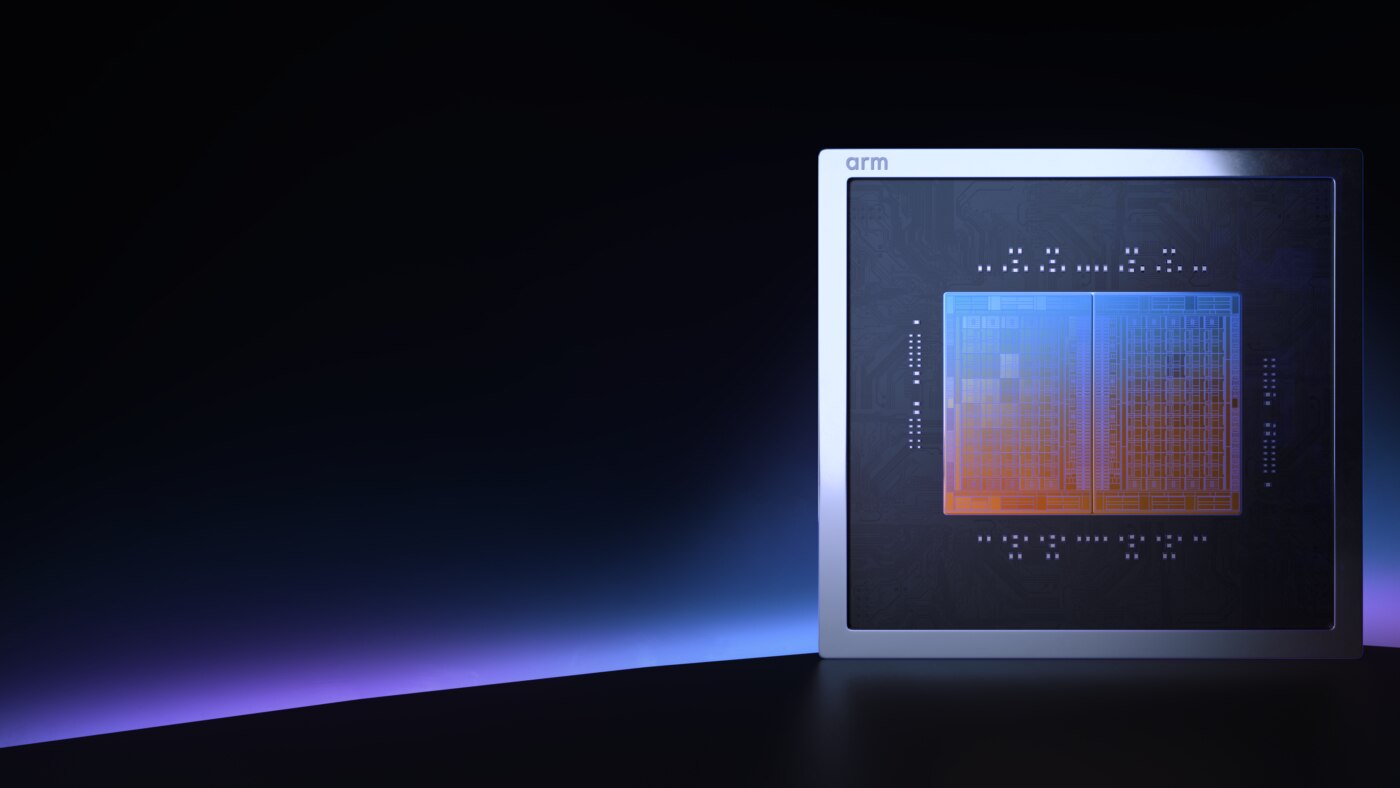
That model is now officially dead. ARM has launched its first ever production CPU chip — the Arm AGI CPU — a 136-core Neoverse V3 package built on TSMC's 3nm process. This is not a reference design. This is not a Compute Subsystem that someone else turns into a chip. This is ARM-designed, ARM-branded silicon shipping to real customers. Meta is first in line, co-developer and lead customer simultaneously.
The implications are seismic. Every chip company that built their data center business on Neoverse IP just became ARM's competitor.
The Architecture: Neoverse V3 at 3nm
The Neoverse V3 core is ARM's highest-performance server core to date, and the AGI CPU stacks 136 of them into a dual-chiplet package on TSMC N3. Each core gets a dedicated 2MB L2 cache — a substantial chunk of per-core cache that pays dividends in inference workloads where cache miss penalties compound across thousands of concurrent requests. Clock speeds top out at 3.7 GHz boost and 3.2 GHz all-core sustained.
Memory architecture is DDR5, not HBM — a deliberate choice optimizing for capacity and cost over raw bandwidth. With 12 DDR5 channels running at up to 8800 MT/s, you get 800+ GB/s of aggregate bandwidth and 6 GB/s per core at sub-100ns latency. For agentic AI inference workloads — where you're running many parallel, medium-sized model invocations rather than massive single-GPU training runs — that latency target matters more than peak bandwidth.
I/O is future-proofed: 96 lanes of PCIe Gen 6 and CXL 3.0 support. The PCIe Gen 6 bandwidth will matter when attaching next-generation accelerators. CXL 3.0 enables memory pooling architectures that are becoming critical for large-context LLM serving. The power envelope sits at 300W — remarkably disciplined compared to AMD's top EPYC Turin variants pushing 500W or Intel's Clearwater Forest Xeon at similar wattage.
Rack Density: Where ARM's Argument Lives
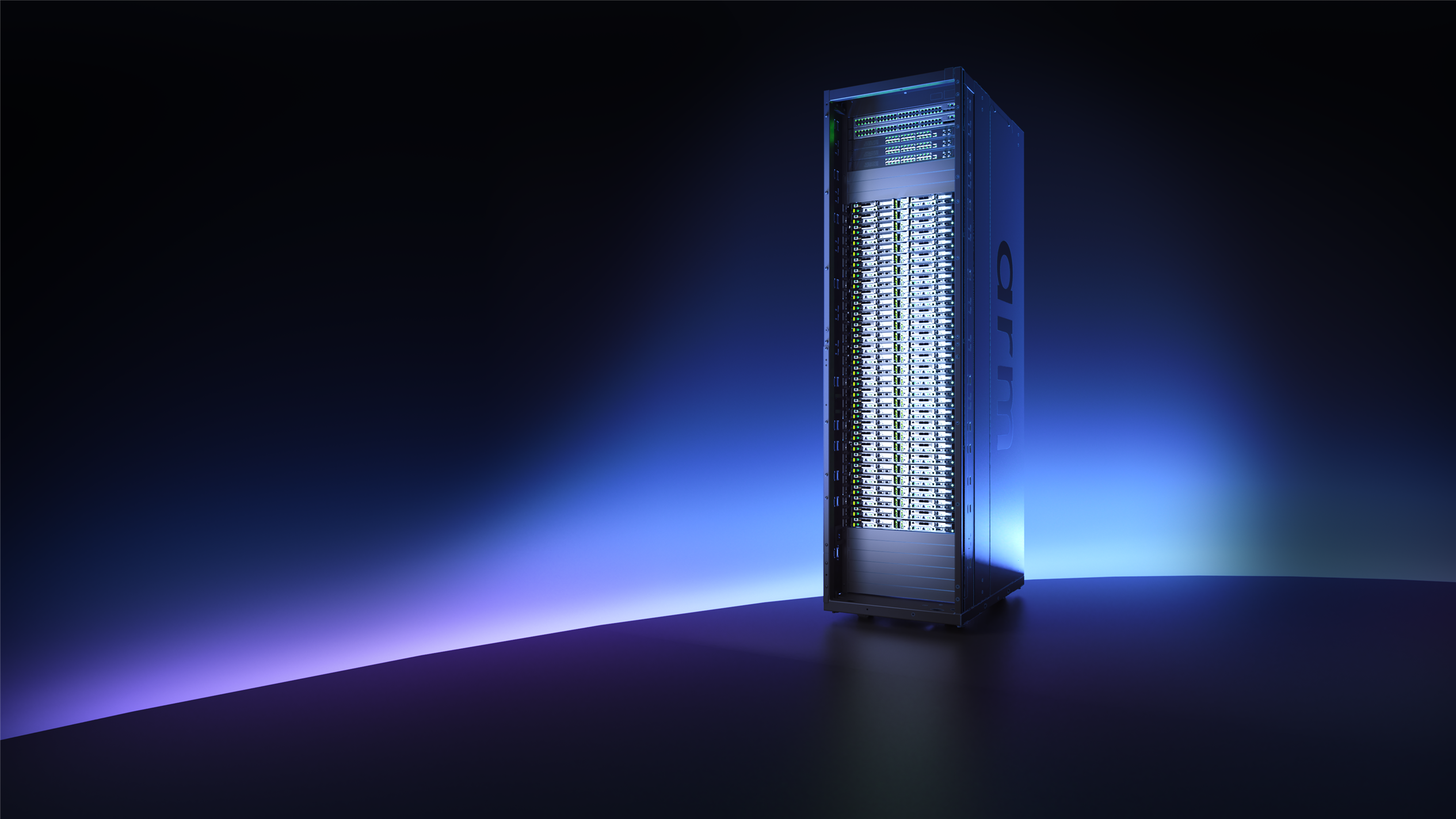
ARM's headline number is rack density, and it's striking. In a 1U dual-node air-cooled configuration, you can pack 8,160 Neoverse V3 cores per rack. Switch to liquid cooling and that number explodes to 45,000+ cores per rack. ARM claims 2x performance per rack versus equivalent x86 deployments.
This is where the $10 billion CAPEX savings claim per gigawatt of AI data center capacity comes from. If you can do the same work with half the rack space, you need less real estate, less power infrastructure, and fewer cooling systems. At hyperscaler scale, those efficiency multipliers become decisive.
The caveats are real: these are ARM's own benchmarks with Meta as co-developer. Independent third-party validation isn't here yet — production shipments don't start until Q4 2026. But the architectural reasoning is sound. Neoverse V3's efficiency story has been building for two generations, and the rack density math is constrained by physics, not marketing copy.
Meta, OpenAI, and the Customer List That Matters
The customer roster signals exactly what ARM is targeting. Meta co-developed the chip. OpenAI, Cerebras, Cloudflare, Rebellions, Positron, SAP, and SK Telecom are signed up. Supermicro, Lenovo, and Quanta Computer are building OEM systems. Over 50 companies are backing the platform.
This is not ARM chasing the general-purpose enterprise server market where Intel's installed base is a fortress. This is ARM going directly after the AI inference infrastructure buildout — the segment growing fastest, where incumbency matters least, and where performance per watt per token is the dominant purchasing metric. Cerebras and Rebellions both run custom AI silicon; they're adding Arm AGI CPUs as the host and orchestration layer. That's a structurally different deployment pattern than replacing a file server.
What This Means for Intel and AMD
Intel currently holds 54.9% of the server CPU market. AMD has fought its way to 27.4%. ARM-based chips already account for 17.7% — before this launch. The trajectory has been consistent: ARM gains share every quarter while Intel bleeds it.
The Arm AGI CPU accelerates that dynamic specifically in AI data centers, the fastest-growing segment. Intel's counter is Nova Lake and Clearwater Forest, but neither is shipping in volume yet. AMD's EPYC Turin is available now and tells its own efficiency story, but it's on a 4nm process versus ARM's 3nm, and the TDP profile runs heavier.
ARM going direct to silicon also changes the competitive calculus for every Neoverse licensee: Ampere Computing, AWS Graviton, NVIDIA's Grace CPU. Some of those companies pay ARM royalties on the IP side. They are now also competing against ARM on the silicon side. ARM has chosen to accept that complicated relationship.
Every Nanometer Counts
The Arm AGI CPU is not a bet that x86 is dead — it's a bet that AI inference will grow fast enough to carve out a massive market where ARM's efficiency advantages compound. At 3nm with 136 cores in 300W, the silicon argument is credible. TSMC N3 yields are mature. The customer list is real. Q4 2026 shipments will produce the independent benchmarks that either validate or demolish the rack density claims under real-world mixed workloads.
ARM showed up to the data center with its own chip. That's a structural shift, regardless of how the benchmarks eventually land. The IP licensing era was thirty years of groundwork. The silicon era is just beginning.
Loading comments...