DDR5 Has a Price Problem — HUDIMM Might Be the Answer
DDR5 has been the standard for two platform generations now, but its cost floor remains stubbornly high. Even the cheapest DDR5-4800 kits hover around $40-50 for 16 GB, and for budget builders on Intel 600/700 series boards, that premium over DDR4 is hard to justify. ASRock thinks it has a fix, and Intel is backing the play.
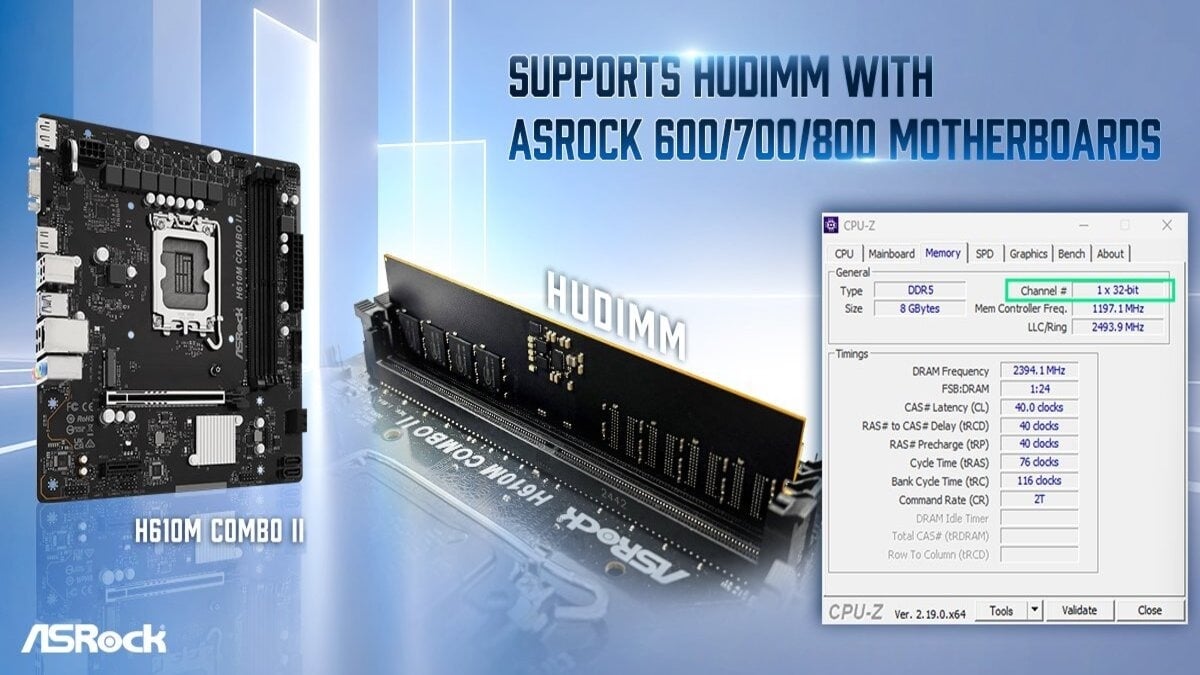
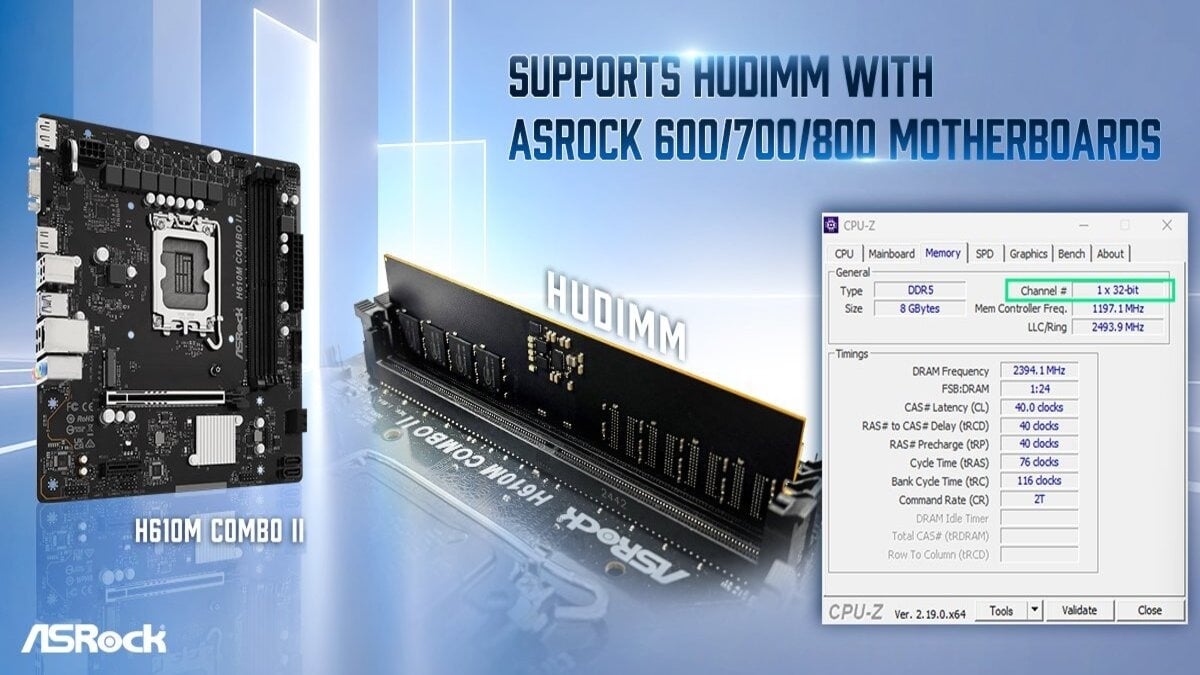
On April 17, ASRock officially introduced HUDIMM — Half-Unbuffered DIMM — a new DDR5 module format developed in partnership with TeamGroup and endorsed by Intel. The concept is deceptively simple: take a standard DDR5 UDIMM's dual 32-bit sub-channel architecture and cut it in half.
How HUDIMM Works: One Sub-Channel, Half the Chips
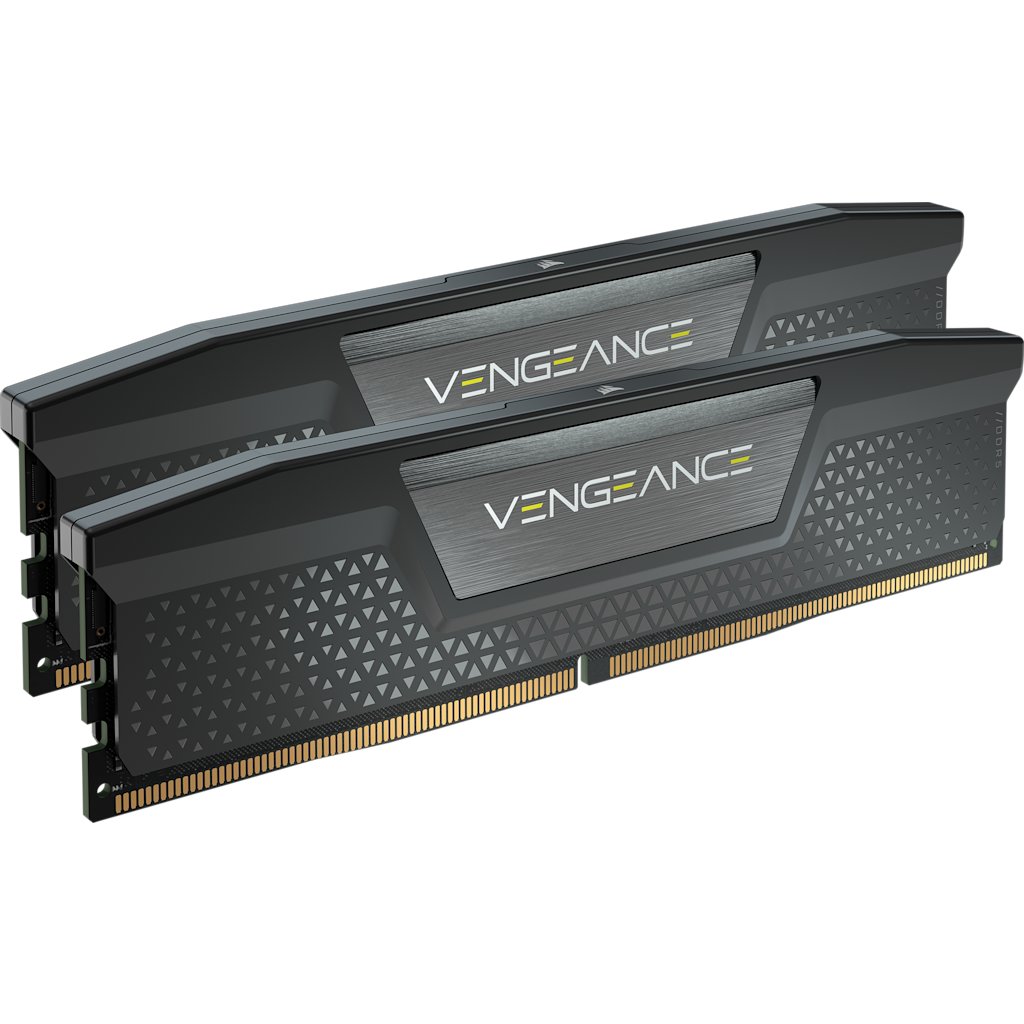
Standard DDR5 UDIMMs use two independent 32-bit sub-channels. This is one of DDR5's defining architectural advantages over DDR4 — it allows the memory controller to issue commands to both channels simultaneously, improving effective bandwidth and reducing access granularity from 64 bytes down to 32 bytes per burst.
HUDIMM strips that down to a single 32-bit sub-channel. In practice, this means a HUDIMM module needs roughly half as many DRAM chips as a standard UDIMM of the same capacity. Fewer chips means lower BOM cost, simpler PCB routing, and cheaper manufacturing overall.
The bandwidth tradeoff is real and unavoidable. A single-subchannel module delivers approximately half the peak bandwidth of a dual-subchannel UDIMM at the same clock speed. For a DDR5-4800 HUDIMM, that works out to roughly 19.2 GB/s per module versus 38.4 GB/s for a standard UDIMM. In latency-bound workloads like gaming, the impact is less dramatic than the bandwidth numbers suggest — but in sustained throughput scenarios like video encoding or large dataset processing, the gap will be noticeable.
The Mixed-Config Trick: Three Sub-Channels from Two Sticks
Here's where it gets interesting. ASRock has validated mixed configurations — pairing a HUDIMM with a standard UDIMM in the same system. On their H610M COMBOII board, they demonstrated an 8 GB HUDIMM alongside a 16 GB UDIMM, creating an asymmetric 24 GB configuration with three active sub-channels (one from the HUDIMM, two from the UDIMM).
ASRock claims this three-subchannel setup actually delivers higher bandwidth than a single 24 GB UDIMM, which only has two sub-channels despite its higher capacity. The logic checks out mathematically: three sub-channels at DDR5 rates should exceed two, even if one of them is operating at a slightly different capacity point. Whether real-world workloads see meaningful gains from this asymmetry will depend heavily on how the memory controller interleaves accesses.
Intel's Endorsement Carries Weight
This isn't just an ASRock side project. Intel's Robert Hallock, VP and GM of the Enthusiast Channel Segment, gave the initiative a rare public endorsement: "Innovations like ASRock's one sub-channel DRAM technology are crucial to ensuring desktop computing remains accessible despite the rising demand and costs for DDR5 memory."
Hallock added that Intel is "grateful for ASRock's support in bringing this to market for our 600/700/800-series chipsets." That's not boilerplate — Intel is explicitly tying HUDIMM to its existing platform ecosystem. ASRock is rolling out BIOS updates across its Intel 600, 700, and 800 series motherboard lineup to enable HUDIMM support, and the company's DeskMini compact PCs will support HSODIMM, a smaller form factor variant.
TeamGroup as Manufacturing Partner
TeamGroup is handling the module production side, building both standard HUDIMM desktop modules and HSODIMM variants for compact systems. No specific SKUs, capacities, or pricing have been announced yet, but the entire point of the initiative is cost reduction — expect modules targeting the 8 GB and 16 GB segments where price sensitivity is highest.
ASUS Jumps In Too
ASRock isn't alone. ASUS has also demonstrated HUDIMM support on its ROG Maximus Z890 Apex board, showing modified modules converting 24 GB sticks down to 12 GB and 16 GB sticks down to 8 GB with single-subchannel operation. When two motherboard vendors and Intel itself are pushing the same standard, it's a strong signal that HUDIMM has legs.
The Bandwidth-vs-Cost Tradeoff
Let's be honest about what HUDIMM is and isn't. It's not a performance play. Anyone building a system where memory bandwidth matters — content creation, high-refresh gaming, memory-heavy compute — should stick with standard dual-subchannel UDIMMs or step up to CUDIMM for even higher speeds.
But for the massive market of office PCs, basic home desktops, and budget gaming rigs where 8-16 GB of DDR5 at adequate speeds is perfectly fine? HUDIMM could meaningfully close the gap between DDR4 and DDR5 pricing. And with DDR4 production winding down, having a cheaper DDR5 option isn't just nice to have — it's becoming essential.
The real question is how much cheaper. If TeamGroup can deliver 8 GB HUDIMMs at $15-20 — roughly DDR4 territory — this standard solves a genuine market problem. At $30, it's a harder sell. We'll know more when actual SKUs hit retail, presumably later this year.
Loading comments...