SLAM Goes Wide
Audeze arrived at AXPONA 2026 with a clear message: SLAM is no longer a flagship privilege. The Symmetric Linear Acoustic Modulator technology, which debuted in the $5,995 CRBN2 electrostatic and then trickled into the $4,500 LCD-5s at NAMM, is now in the $499 LCD-S20 closed-back and the Maxwell 2 gaming headset. Four products across four price tiers, all sharing the same acoustic architecture. That is either a genuine democratization story or an aggressive product line alignment — probably both.
What SLAM Actually Does
The name is blunt marketing, but the mechanism is real. SLAM integrates precision-engineered acoustic channels into the ring that connects the earpads to the driver housing. These channels do two things simultaneously: they relieve the pressure buildup that occurs behind a planar magnetic driver under heavy excursion, and they modulate low-frequency airflow in a way that extends effective bass response without adding electrical bass boost. The result is bass that claims to reach 5Hz on the LCD-5s and CRBN2, 10Hz on the LCD-S20 and Maxwell 2 — without DSP, without EQ, without the phase artifacts that come from corrective processing.
Flat response is just the beginning. What SLAM is actually targeting is the dynamic behavior below 40Hz, where planars have historically compressed rather than extended. The physics are straightforward: acoustic pressure management lets the diaphragm move more freely at low frequencies, which reduces the mechanical limitation that causes that compression. Whether Audeze's implementation fully delivers on that in a $499 closed-back will need independent measurement to confirm. The claim is that it does.
The LCD-S20: The One That Changes the Equation
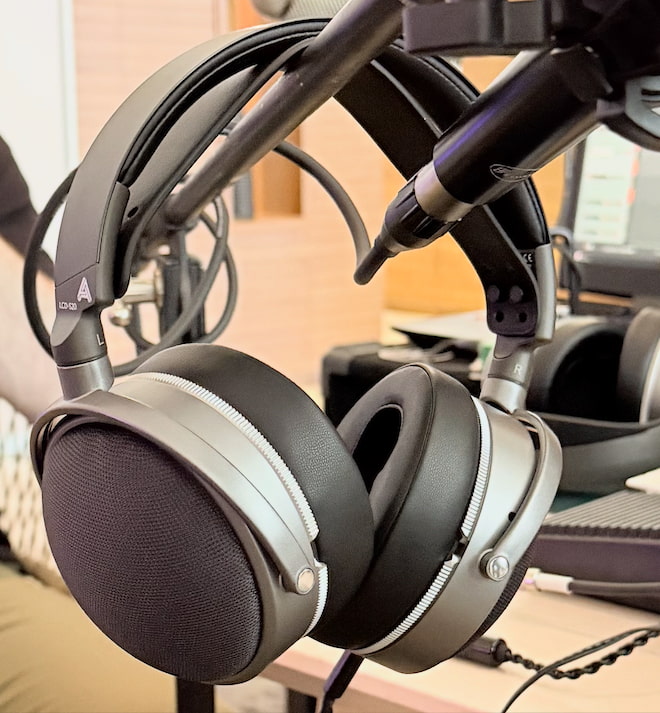
The LCD-S20 is the announcement that matters most. It is a 90mm planar magnetic closed-back headphone at $499 — the same driver diameter Audeze uses in the LCD-5s flagship. The specs are immediately interesting: 18-ohm impedance, 93 dB/mW sensitivity, THD below 0.1% at 100dB SPL. At 18 ohms, this is significantly easier to drive than the LCD-5s at 30 ohms or the company's legacy planars that regularly demanded dedicated amplification. A decent portable DAC/amp will run it.
The design rationale is studio-focused: closed-back isolation for tracking and recording, where an open-back like the MM-100 or LCD-5s bleeds into microphones. The earpad attachment uses a new magnetic system — tool-free, user-replaceable — which signals that Audeze expects this to live on heads for long working sessions with regular pad wear. The build uses magnesium, aluminum, and steel. At 550 grams it is not light, but that weight budget is going into the magnet structure, not premium cosmetics.
LCD-5s and CRBN2: SLAM at the Top
For those already invested in the flagship tier, the LCD-5s with SLAM represents the most technically refined iteration of Audeze's flagship planar to date. The nano-scale Parallel Uniforce diaphragm, Fluxor neodymium N50 magnet arrays, and Fazor waveguides remain from the original LCD-5, but SLAM adds the acoustic pressure management that reportedly improves low-end linear extension while keeping the midrange characteristic — which reviewers consistently describe as slightly pulled back and relaxed — intact. The 5Hz-to-50kHz rated frequency response now has mechanical support for the bottom end that the original design had to achieve through diaphragm compliance alone.
The CRBN2 electrostatic with SLAM is a different story entirely. Electrostatics already achieve exceptionally low distortion through their operating principle — the diaphragm moves uniformly in a uniform electric field. What SLAM adds to an electrostatic is acoustic rather than electrical: the same low-frequency airflow modulation that helps the LCD-S20 and LCD-5s, applied to a stator-driven film driver. The result is a more forward presentation than the LCD-5s, with more energy in the upper midrange and lower treble, according to those who heard it at the show.
Maxwell 2 and the reSkin Program
The Maxwell 2 gaming headset with SLAM is the outlier in this lineup, and deliberately so. Audeze is clearly trying to close the gap between their reference audio reputation and the gaming market, where the original Maxwell found a dedicated following despite its audiophile price point. The reSkin program — interchangeable faceplates with gaming-themed aesthetics that attendees voted on at AXPONA — is either a smart product ecosystem play or an attempt to make the headset feel more alive than a fixed design. The 10Hz-to-50kHz frequency response with SLAM puts it acoustically closer to the LCD-S20 than to any gaming headset in its category.
What AXPONA Confirmed
AXPONA 2026 delivered a record attendance and a show floor that validated the current health of personal audio as a category. But Audeze's presence was notable for strategic coherence: one technology, rolled down the price stack simultaneously, with products at $499, gaming-headset pricing, $4,500, and $5,995. The LCD-S20 in particular positions SLAM not as a luxury acoustic feature but as a standard design element — the same way Fazor waveguides became standard across the LCD lineup years ago. If the LCD-S20 measures well when independent data arrives, the closed-back planar market under $500 just got considerably more interesting.
Loading comments...