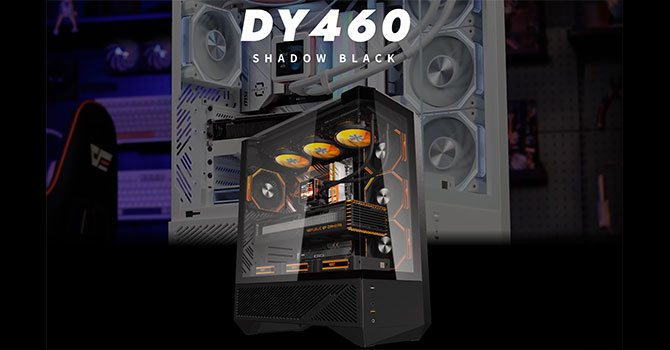
The Angular Aesthetic Gets a Smaller Footprint
The darkFlash DY470 turned heads last year with its angled surfaces and aggressive geometry. It looked like nothing else on the market, but it was also large — a dual-chamber design that consumed serious desk real estate. The new DY460 takes that same design language and compresses it into a conventional mid-tower layout that occupies 23% less space.
At 452 x 238 x 541 mm, the DY460 is compact for an ATX mid-tower. It supports ATX, microATX, and Mini-ITX motherboards, offers 400 mm of GPU clearance and 180 mm of CPU cooler height. These are not cramped dimensions. A full-size RTX 5080 fits without interference. A Noctua NH-D15 or comparable tower cooler clears the side panel. The reduction in volume comes from eliminating the DY470's dual-chamber architecture, not from sacrificing component compatibility.
Airflow is not optional, it's physics — and the DY460 takes a side-intake approach that has become increasingly common in modern case design.
Cooling Layout and Airflow Path
The DY460 ships with four 120 mm ARGB fans: three on the side intake and one at the rear exhaust. The side-mounted intake pulls cool air directly across the GPU, which is the correct priority in modern builds where graphics cards are the primary heat source.
Radiator support is generous for the price. The top accommodates a 360 mm radiator with three 120 mm fan positions. The rear supports a 120 mm or 140 mm radiator. This means you can run a 360 mm AIO on the ceiling as exhaust while keeping the side fans as intake — a configuration that creates strong negative-to-positive pressure balance depending on fan curve tuning.
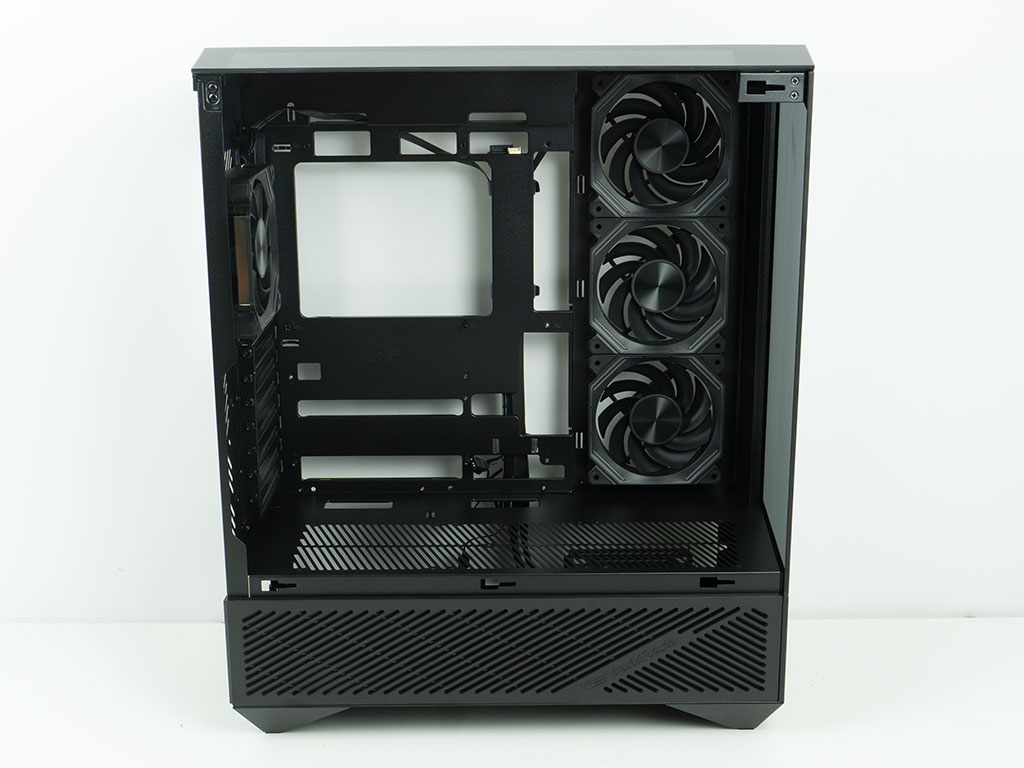
The absence of 140 mm ceiling fan support is the one notable thermal limitation. Cases in this class increasingly offer 140 mm options at the top, which provide higher airflow per RPM and lower noise. At $125, this is a reasonable cost-saving measure, but it does limit cooling flexibility for users who prefer larger, slower fans.
BTF and Cable Management
BTF — or back-to-front — motherboard support is the DY460's most forward-looking feature. BTF-compatible motherboards route all power and data connectors to the rear side of the PCB, which eliminates visible cables from the main chamber entirely. The result is a build that looks clean without any cable management effort.
For conventional motherboards, the DY460 provides standard cable routing channels, though TechPowerUp's review notes the absence of rubber grommets on the routing holes. This is a minor but real annoyance during builds — grommets prevent cable rattle and give a cleaner visual finish. Three Velcro strips are included for cable bundling behind the motherboard tray.
The Bent Glass Question
The DY460 uses a bent tempered glass panel that wraps around the front-side edge of the chassis. It looks distinctive — the curvature catches light differently than a flat panel and reinforces the angular aesthetic. However, bent glass is a polarizing choice. It is more expensive to manufacture, harder to replace if cracked, and the curvature can create visual distortion when viewing components at certain angles.
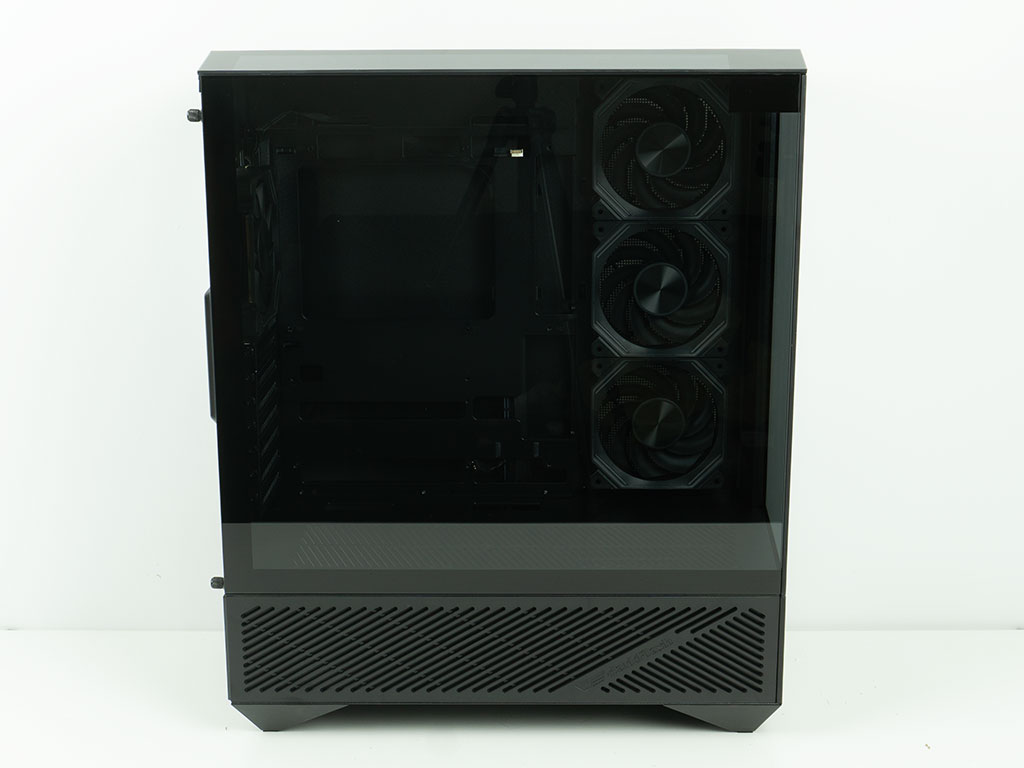
From a thermal perspective, the glass panel is not a concern here. The primary airflow path runs through the mesh side panel on the opposite side, so the glass is essentially a display window rather than an airflow surface. Solid engineering decision — keep the pretty side sealed, keep the functional side permeable.
Storage and I/O
Internal storage includes two 3.5-inch and one 2.5-inch drive bays. Front I/O offers USB 3.2 Gen 2 Type-C, one USB 3.0 Type-A, and an audio combo jack. The single USB-A port is the DY460's most puzzling cost cut. Most competing cases at $100-125 include two USB-A ports. Losing one to save a few cents on BOM cost feels unnecessary, and it will annoy anyone who regularly plugs in peripherals through the front panel.
The HDD cage also requires tipping the case to access mounting screws, and the bottom dust filter demands flipping the entire chassis for removal. These are ergonomic oversights that suggest the internal layout was optimized for first-time assembly rather than ongoing maintenance.
The $125 Proposition
TechPowerUp awarded the DY460 a 5/5 rating and a Recommended badge. At $125, it sits above the budget ATX pack ($90-100 range) but justifies the premium through its four included ARGB fans with daisy-chain connectivity, the bent glass panel, and BTF support.
The competitive landscape at this price includes the Corsair 3200D RS ARGB (sub-$100 but with fewer fans and limited functionality) and the Antec Flux Pro (similar price but less distinctive aesthetics). The DY460 differentiates itself primarily on design — no other case at $125 looks like this.
For builders who want a compact, visually distinctive ATX mid-tower with adequate cooling and modern BTF support, the DY460 makes a convincing case. The missing grommets and single USB-A port are real but minor complaints. The thermal design, component clearance, and fan configuration are all well-executed for the segment.
Loading comments...