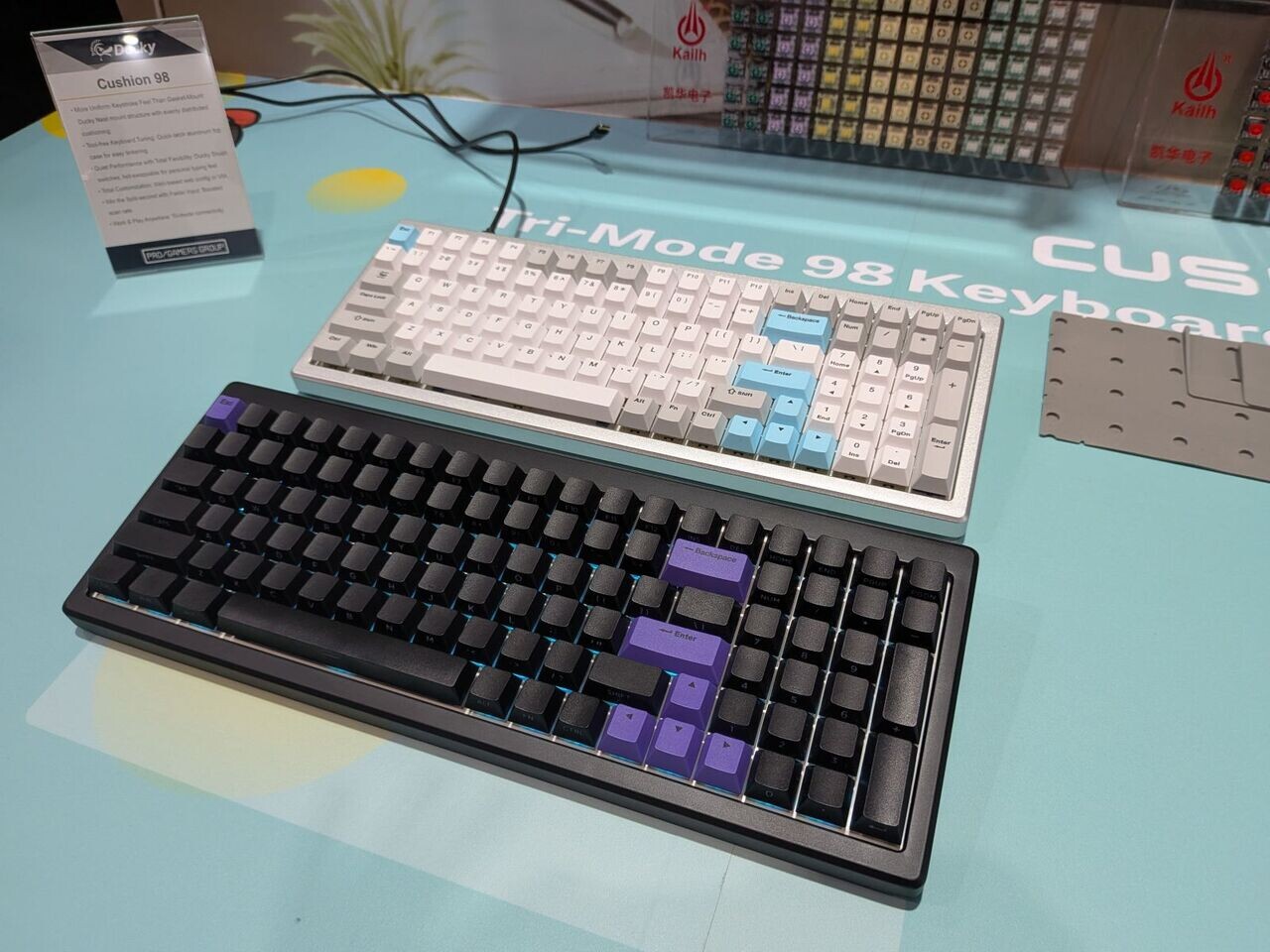
Ducky Finally Gets Serious About Feel Again
Ducky showed up at Computex 2026 with a keyboard lineup that reads like a checklist of everything the enthusiast scene has been demanding: softer mounting, hot-swap switches, tri-mode wireless, layered dampening, Hall-effect input, Rapid Trigger, SOCD, and actual layout choice. The headliner is the Cushion 98, a 980-layout board built around Ducky’s new Nest Mount system, but the bigger story is that Ducky now has a full ladder: comfort-focused Cushion, affordable OK-M, and performance-focused OK-HE.
Cushion 98: The Anti-Brick 980 Board
The Cushion 98 is the one I want to put fingers on first. A 980 layout gives you the numpad cluster without the full aircraft-carrier footprint, and Ducky is pairing it with a removable aluminum top case for tool-free tuning. The new Nest Mount is the key detail: instead of a generic gasket implementation, Ducky says it uses two cushioning layers so users can tune how soft the bottom-out feels. That matters. A board can be gasket-mounted and still feel like typing on a cafeteria tray if the stack is wrong.
It also uses hot-swappable Ducky Shush switches and south-facing RGB. The switch name is not subtle, but if Ducky has actually tuned these toward a muted, rounded bottom-out rather than the usual scratchy stock clack, I am listening. Thock is a feeling, not a sound.
OK-M Is the Budget Sleeper
The OK-M series may be the most important board here because it is already available and priced between $70 and $90 depending on layout. That gets you 980, 75%, and 65% options, gasket mounting, hot-swap KTT linear or tactile switches, tri-mode connectivity, side RGB, and five layers of acoustic dampening. Five layers at this price point is not automatically magic — foam can fix hollowness or suffocate a board — but it tells me Ducky knows the budget fight is now about sound profile as much as switch brand.
This is where the market has changed. A $90 keyboard in 2026 cannot just be “mechanical.” It has to arrive pre-tuned enough that a normal buyer does not need painter’s tape, PE foam, and a Saturday afternoon to remove case ping.
OK-HE Is Ducky Chasing the Wooting Crowd
The OK-HE series is the gaming punchline: Hall-effect analog input, Rapid Trigger, SOCD, controller simulation, tri-mode connectivity, and an 8 kHz polling rate. TechPowerUp notes Ducky is promising “8x faster input,” which lines up with the jump from the usual 1,000 Hz keyboard polling rate to 8,000 Hz. Does every player need 8 kHz? No. Will competitive keyboard marketing stop talking about it? Also no.
The more meaningful part is Rapid Trigger and SOCD. Adjustable actuation and reset points are what make magnetic switches feel different in-game: you are no longer waiting for a fixed mechanical leaf to reset. For counter-strafing, rhythm games, and movement-heavy shooters, that changes the board from a typing tool into an input instrument.
The Zodiac Board Is the Collector Bait
Ducky also showed a Cushion 98 Year of the Horse Edition, continuing its Year of the Zodiac series. Last year’s Year of the Snake model was limited to 2,025 units and sold around $200, though Ducky has not confirmed production count or pricing for the new Horse edition yet. Themed boards can get tacky fast, but Ducky’s Zodiac editions have historically understood the assignment: strong visual identity without turning the keyboard into a toy shelf.
The Takeaway
This is Ducky modernizing without abandoning what made people care about the brand in the first place. The Cushion 98 is about typing feel, the OK-M attacks the sensible budget tier, and the OK-HE acknowledges that magnetic switches are no longer a niche experiment. If Ducky nails the stabilizers and keeps the acoustics controlled — no rattly spacebar, no metallic top-case ping, no over-damped deadness — this could be one of its strongest lineups in years.
Loading comments...