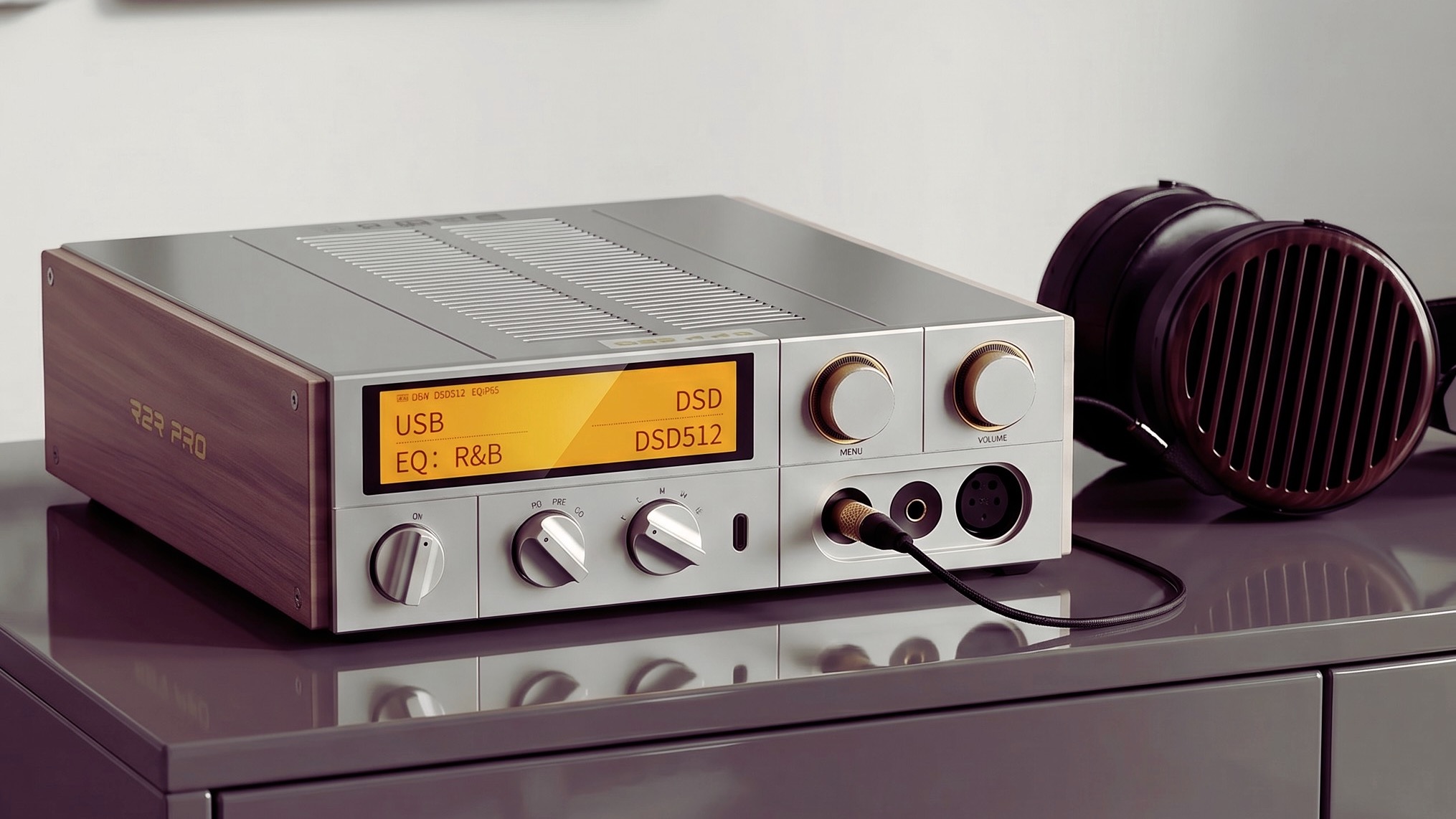
R2R Goes Mainstream
For the better part of a decade, R2R (resistor ladder) DAC architecture has been the domain of boutique manufacturers — Denafrips, Holo Audio, Lampizator — charging $800 and up for a DAC *alone*, let alone a complete headphone system with streaming and EQ. FiiO is about to change that math. The K17 R2R Pro, teased ahead of its High-End Vienna debut, combines a proprietary 5+24-bit R2R PRO resistor array, discrete Class AB amplification rated at 4,000mW balanced, built-in Wi-Fi streaming, and a 31-band parametric EQ — all in a unit targeting below $1,000. Flat response is just the beginning, and R2R architecture is how you get there without delta-sigma's characteristic noise-shaping artifacts coloring the upper frequencies.
What 5+24-bit R2R Actually Means
FiiO's "5+24-bit R2R PRO" nomenclature deserves unpacking. In a resistor ladder DAC, each bit of the digital signal controls a precision resistor that directly sets an analog voltage level. No oversampling, no delta-sigma noise shaping — the analog output is a direct consequence of resistor matching quality. FiiO's design splits the ladder into a 5-bit coarse section for the most significant bits (where absolute accuracy matters most) and a 24-bit fine section for detail resolution. This segmented ladder approach manages the exponentially tighter tolerances required at the MSB end while keeping the BOM cost realistic.
Critically, the K17 R2R Pro includes both NOS (Non-Oversampling) and OS (Oversampling) playback modes. NOS preserves the time-domain character many listeners prefer — waveforms reconstructed exactly as the digital data specifies, with no digital filter pre-ringing. OS mode adds FIR filtering that attenuates sharply above 20kHz, trading some time-domain precision for cleaner stopband behavior. Having both on a single unit is the right call: NOS for well-mastered recordings, OS for content that benefits from the extra filtering.
4,000mW, a 35W Linear PSU, and a USB Isolator
The amplifier section uses a discrete Class AB transistor circuit with current boosting, specified at 4,000mW + 4,000mW balanced. That's enough headroom to drive notoriously power-hungry planar magnetics — Audeze LCD classics, HiFiMAN Arya — without reaching for an external amp. Outputs include a 4.4mm Pentaconn balanced socket, balanced XLR, and a standard 6.35mm single-ended jack.
The power supply choice is significant: a 35W low-noise linear PSU rather than a switching supply. R2R resistor arrays are directly sensitive to power rail cleanliness in ways that oversampling delta-sigma chips — with their own internal noise shaping — simply aren't. A linear PSU here isn't audiophile theater; it's correct engineering for the architecture. FiiO also adds a USB ground loop isolator on the digital input side, which handles the 50/60Hz hum that plagues USB DAC connections from laptop docks and gaming PCs on shared ground planes.
Streaming is handled by dual-band Wi-Fi (2.4/5 GHz) and Gigabit Ethernet with QPlay support, accessible from a 3.93-inch touchscreen or via smartphone app. The 31-band parametric EQ with Auto EQ functionality rounds out the feature set — controversial in R2R circles, but correctly implemented as an optional layer rather than a forced insertion in the signal path.
The Market Disruption
The K17 R2R Pro's positioning is genuinely disruptive. The R2R desktop market has been segmented between DAC-only solutions from Denafrips and Holo Audio — which require a separate headphone amp to be useful — and integrated all-in-one units that almost universally use delta-sigma DAC chips. The Denafrips Ares II at $799 and Pontus II at $1,699 are DAC-only; add a capable headphone amp and you're well past $1,500 and $2,500 respectively. Holo Audio's Spring 3 is similarly DAC-only at $1,798.
FiiO bundling a 4,000mW balanced amp, R2R DAC, streaming endpoint, and parametric EQ into a sub-$1,000 package collapses that mental accounting exercise. The only meaningful all-in-one R2R competitor at higher resolution is the iFi iDSD Phantom at $4,499 — a unit with quad Burr-Brown DACs, 4,676mW balanced output, and an optional tube stage. The Phantom is the more accomplished product, but it's 4-5x the K17 R2R Pro's expected price. FiiO isn't competing with the Phantom; they're making the decision to spend $4,499 feel unnecessary for the majority of serious headphone listeners.
What to Listen For
The proof will be in the measurements and listening impressions when review units ship ahead of the mid-2026 availability date. The key questions: how well-matched are the resistors in the actual production units (channel imbalance at low volumes is the classic tell for ladder DAC cost-cutting), what's the noise floor and THD+N in balanced mode, and does the OS mode's digital filter implementation introduce pre-ringing that undermines the architecture's core advantage. The 35W linear PSU and USB isolator are both good omens. FiiO's track record with the K9 Pro and K15 suggests they understand desktop audio at a system level, not just as a spec sheet exercise. High-End Vienna will be the first real public listen.
Loading comments...