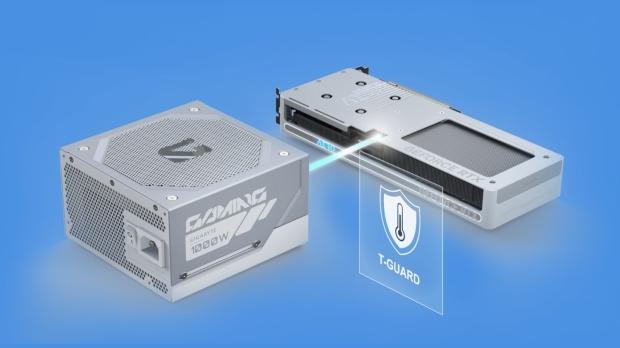
A Thermistor Inside the Connector. About Time.
We have spent three years watching 12VHPWR and its 12V-2x6 successor melt itself into infamy on RTX 4090s, RTX 5090s, and now anything pulling north of 450W through a single connector. The industry response has been a parade of finger-pointing — bad seating, bad bend radius, uneven current distribution across the six 8-amp pins — and a spectacularly slow march toward actually instrumenting the failure point. Gigabyte's new GAMING series PSUs, which launched on April 16th, finally do the obvious thing: they put thermistors **inside the 12V-2x6 connector itself**, where the heat actually lives.
This is what should have shipped with the first 600W ATX 3.0 units back in 2022. Better late than never.
How T-Guard Actually Works
The T-Guard system embeds temperature sensors directly into the PSU-side of the 12V-2x6 cable. When the connector temperature crosses Gigabyte's danger threshold, the PSU does not slam the entire system off — it specifically reduces power delivery to the GPU rail while keeping everything else running. You get the chance to save your work, close your tabs, and shut down cleanly before the connector turns into solder candy.
This is the right behavior. The dominant 12V-2x6 failure mode is not a sudden short — it is gradual contact resistance creep, where one or two pins carry disproportionate current, heat up, oxidize, and run away thermally over minutes. A connector pulling 12A through a single pin (rated for 8.33A continuous on the spec sheet) does not explode immediately. It cooks. Catching that in real time, at the source, with a thermistor measuring the actual junction temperature, is the entire ballgame.
The cable itself uses a dual-color design so you can visually verify orientation during install — a small but welcome concession to the reality that humans are bad at seating connectors blind behind a GPU.
The Rest of the Spec Sheet Is Serious
The T-Guard headline shouldn't bury the lede on the rest of these units. Gigabyte is shipping 750W, 850W, and 1000W variants, all certified to **Cybenetics ETA Platinum** while carrying 80 Plus Gold on the older standard. ETA Platinum is the harder certification — it measures real-world average efficiency across multiple load points and ambient temperatures, not just three load points at 23°C. A unit that earns ETA Platinum is genuinely efficient under the messy conditions inside an actual chassis, not just in a thermally controlled lab.
Noise is rated under 20 dB(A) average — Cybenetics Lambda A+ territory — courtesy of a 135mm fluid dynamic bearing fan and HybridCool zero-RPM mode at low loads. A 135mm FDB at sub-20 dB is what you want behind a quiet build; the larger diameter lets the fan move air at lower RPM, which keeps the bearing whine out of the audible range.
The internals: 100% Japanese capacitors, ATX 3.1 and PCIe 5.1 compliance (so the transient response handles RTX 50-class power excursions without tripping OPP), and a 10-year warranty. The 10-year is the tell — manufacturers do not warranty PSUs that long unless their MTBF math is solid.
Why This Matters for Thermal Design
From an airflow and thermal design standpoint, T-Guard fundamentally changes the failure-mode geometry inside a case. Until now, the 12V-2x6 connector has been a thermal blind spot: tucked behind a 350W+ GPU, often with ambient air around it already pre-heated to 45-50°C by the GPU's exhaust, with zero direct sensing. You could have a connector running at 110°C and your fan curve would have no idea.
With thermistors at the source, you finally have closed-loop protection on the actual hot spot. This also means PC builders can stop relying on indirect mitigations — angled adapters, oversized cable bend radii, custom risers that move the GPU away from the connector — as the only line of defense. Those are still good practices. But now there is a second line.
The other thing engineering-minded buyers will appreciate: this is a proper PSU thermal protection scheme, not a gimmick LED. No RGB. No app required. The thermistor is hardware, the protection logic is in the PSU's MCU, and it works whether or not you have software installed. That is how safety features should be implemented.
What I'd Still Like to See
A per-pin current sensor would be the next logical step — the actual root cause of 12V-2x6 failures is current imbalance across the six 12V pins, and a thermistor measures the consequence rather than the cause. ASUS has been hinting at per-pin monitoring on its ROG Equalizer cable, and that is the architecture the entire industry should converge on.
The second thing missing from Gigabyte's announcement: pricing and exact regional availability. The 750W/850W/1000W lineup will compete directly with Corsair RM-x Shift, Seasonic Vertex GX, and MSI's MEG Ai units — all of which are ETA Platinum and around $130-$200. If Gigabyte prices these at parity and the warranty service holds up, the connector thermistor alone is enough to recommend them over anything that lacks the feature.
For anyone building a 5080 or 5090 system right now, this is the safety mechanism you have been waiting for. Airflow is not optional, it's physics — and now, finally, neither is monitoring the one connector in your case that has been quietly trying to start fires.
Loading comments...