AMD Has Owned the Gaming CPU Market for Three Years. That Might Be About to Change.
Since the Ryzen 7 5800X3D landed in 2022, AMD's 3D V-Cache technology has been the answer to every serious gaming PC builder's CPU question. The formula is brutal in its simplicity: stack 64 MB of SRAM directly on top of the compute die, balloon the effective L3 cache to 96–128 MB, and watch frame rates climb because the CPU almost never has to wait on slow main memory for game data. Intel's response — faster cores, higher clocks, more PCIe bandwidth — never addressed the actual bottleneck. Now, with Nova Lake, Intel is finally answering the right question.
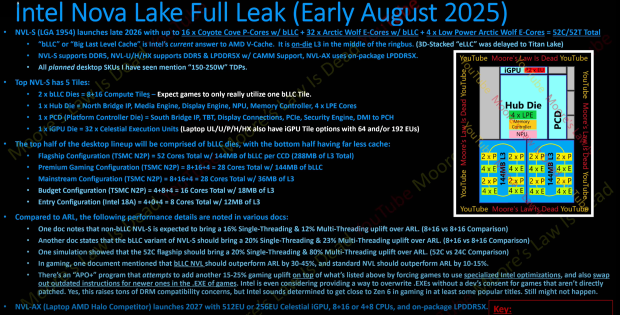
Leaks consolidating around the Core Ultra Series 4 "Nova Lake" platform, expected late 2026, show Intel going nuclear on cache. The flagship dual-die configuration carries **288 MB of Big Last Level Cache (bLLC)** — more than double AMD's 128 MB in the best Ryzen 9000X3D parts. Single-die mainstream SKUs with bLLC land at 144 MB. Intel is calling this architecture the center-ring design, placing the bLLC tiles in the ringbus interconnect path to minimize latency rather than stacking them vertically like AMD's bonded approach.
What bLLC Actually Is — And Why the Die Size Matters
AMD's 3D V-Cache works by bonding a separate SRAM chiplet on top of the compute die using hybrid bonding — a manufacturing process that Intel has been slower to adopt at consumer scale. Intel's bLLC takes a different path: the cache is integrated *within* the compute tile itself, fabricated on the same TSMC N2P node as the cores. The trade-off is die area. A standard Nova Lake compute tile measures around 98 mm²; the bLLC variant balloons to 154 mm² to accommodate the additional SRAM. That extra silicon costs money, which is why early pricing leaks for the 52-core dual-bLLC flagship are pointing north of $1,200.
The architectural difference matters for latency profiles. AMD's stacked cache sits above the core, and the signal path adds a small but measurable penalty. Intel's on-die placement should deliver slightly lower absolute cache latency — but whether that translates to real-world gaming gains over AMD's proven approach remains to be seen in actual benchmarks. What we do know from leaked projections: bLLC Nova Lake is expected to deliver **30–45% higher gaming frame rates than Arrow Lake** at CPU-limited resolutions, versus just 10–15% for non-bLLC variants.
The Core Architecture: Coyote Cove Finally Fixes Intel's Single-Thread Problem
Beyond the cache story, Nova Lake marks the debut of **Coyote Cove P-cores** — Intel's next-generation performance architecture replacing Arrow Lake's Lion Cove. The projected IPC gain over Lion Cove is around 15%, which compounds with the bLLC advantage in gaming workloads. For non-gaming workloads, the full lineup spans 35 W to 175 W TDP, with core configurations from 8 cores (4P + 4 LP-E) at the budget end up to 52 cores (16P + 32E + 4 LP-E) at the flagship. The multi-thread story at the top end is genuinely compelling for content creators — 23% multi-thread improvement over Arrow Lake in the bLLC configuration, according to the leak data.
Memory support jumps to **DDR5-8000**, which is a meaningful platform upgrade. Arrow Lake's official DDR5 support topped out at DDR5-6400 on the Z890 platform; reaching 8000 MT/s required heavy overclocking and tuning. Nova Lake appears to certify 8000 MT/s natively, which should improve the non-cache memory bandwidth path for workloads that aren't cache-bound. Platform connectivity also gets a major bump: up to 36 PCIe Gen 5 lanes, Thunderbolt 5 natively on desktop (a first), Wi-Fi 7, and support for up to eight SSDs. The new LGA 1954 socket is larger than LGA 1700, though Intel is promising forward compatibility with some 900-series chipsets.
The Intel NPU 6 and the AI Angle Nobody Asked For
Intel is also bundling its NPU 6 neural processing unit into Nova Lake, presumably to hit Microsoft's Copilot+ certification requirements and maintain relevance in the enterprise laptop-conversion market. For desktop gaming and workstation users, the NPU is noise — it won't affect gaming frame rates or rendering throughput. The more interesting AI-adjacent feature is that higher core counts and cache genuinely benefit AI inference workloads running on-CPU (think local LLM inference where you're fitting a 7B or 13B model into LLC). At 288 MB of cache on a 52-core part, Nova Lake could be legitimately interesting for CPU-side inference tasks that current Intel chips can't handle efficiently.
What This Means for AMD's Roadmap
Here's where it gets uncomfortable for AMD: Zen 6 desktop ("Olympic Ridge") has been pushed to 2027. AMD's next X3D response to Nova Lake bLLC won't be a 2026 product. That means AMD's current Ryzen 9000X3D lineup — excellent chips, genuinely — will be competing against Nova Lake bLLC at the high end of the gaming CPU market with no refresh in sight. If Intel's 30–45% gaming uplift projections hold even partially in independent testing, the Ryzen 7 9800X3D's four-year run as the default gaming CPU recommendation is finally over.
Every nanometer counts — and with TSMC N2P, Intel is finally on the right process at the right time with the right cache architecture. Late 2026 can't come soon enough.
Loading comments...