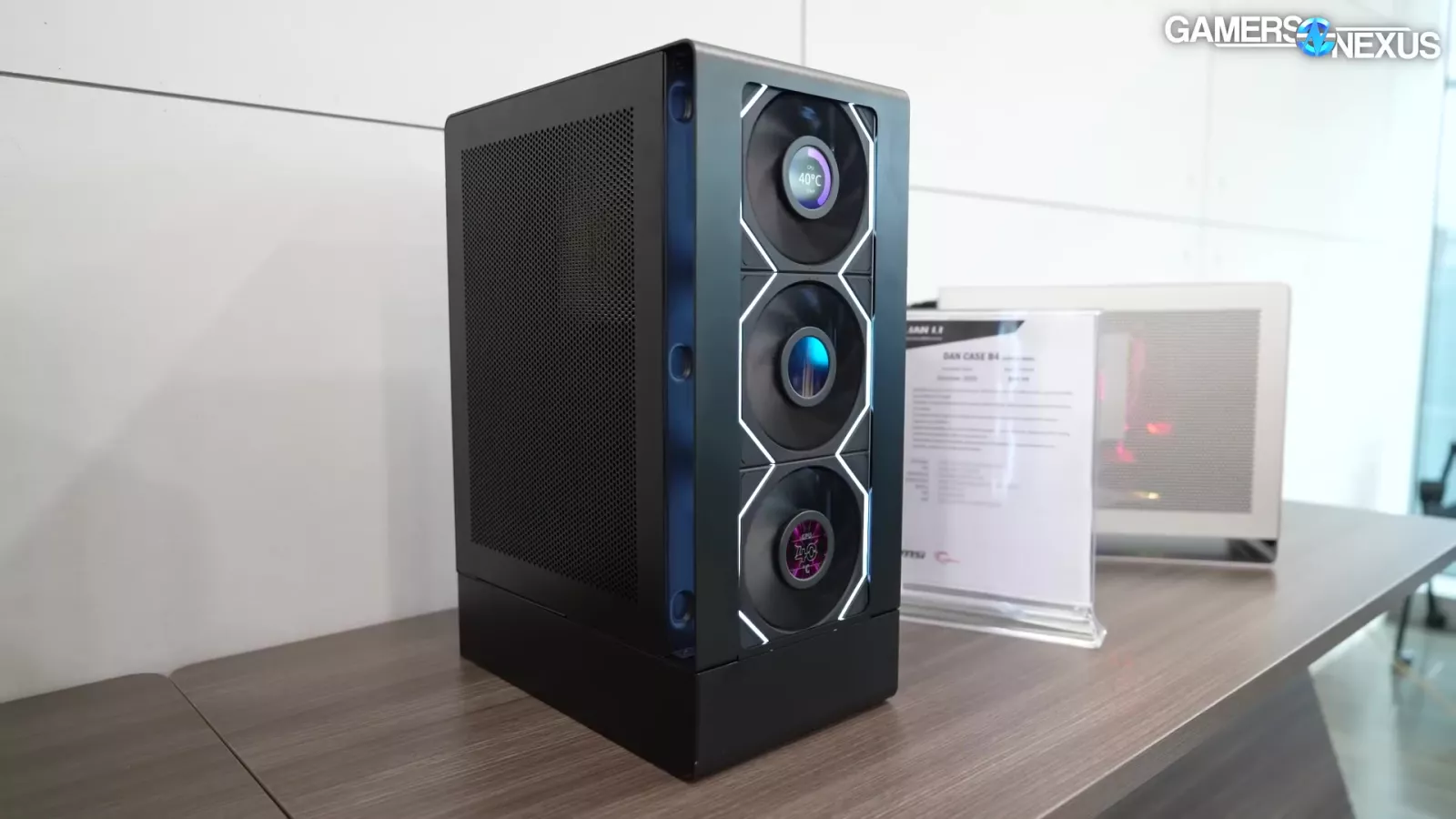
A 21.3-Liter Box That Eats a 360mm Radiator
The Lian Li B4-mATX, co-developed with DAN Cases, is finally hitting shelves this month at $85. On paper, the spec sheet looks like someone forgot a decimal point: 21.3 liters of internal volume, support for a 360mm AIO, GPUs up to 358mm long, a full-size 140mm ATX PSU, and dual slim top fans pre-installed. Wood or mesh front panel options. Horizontal or vertical orientation. For the price of a decent set of fans.
Airflow is not optional, it's physics — and a case this small forces every thermal decision into a corner. So let's actually look at what's happening inside this thing.
The Volumetric Reality Check
21.3L is genuinely small. For context, the Fractal Terra is 10.4L, the NR200P is 18.8L, the SSUPD Meshroom S is 14.9L, and the Lian Li A4-H2O sits at 11L. The B4 is closer to a regular ITX tower than a true SFF chassis, but it's still mATX-capable. That's the trick — DAN Cases' design language has always been about packing standard motherboards into volumes that have no business hosting them.
The pedestal layout — that's the key. By rotating the GPU and CPU into separate thermal chambers, you sidestep the classic SFF problem of GPU exhaust dumping straight into the CPU intake. The B4's prototype at Computex 2025 already showed the GPU fans sitting directly against front intake fans, which on paper gives you cold air straight to the die. Beautiful for thermals, terrible for acoustics if you don't tune the curves.
The 360mm AIO Asterisk
Here's the part the spec sheet doesn't tell you. Lian Li disclosed at the prototype reveal that roughly 30% of one radiator fan is obstructed by a structural metal wall in the original design. They're talking about perforating it for the production run, but anyone who's run CFD on partially blocked radiators knows what happens: static pressure drops asymmetrically across the fin stack, hot spots develop on the obstructed side, and effective dissipation collapses well below what the radiator surface area suggests.
A 360mm AIO that performs like a 280mm AIO is still a 280mm AIO. If Lian Li perforates aggressively in the shipping units, the penalty drops to single-digit percentages. If they don't, expect 5-8°C higher CPU temps under sustained load compared to an unobstructed mount.
PSU Choice Matters More Than Usual
The B4 supports 140mm ATX PSUs, which is the longest you can reasonably run in this footprint. That's a smart constraint — it locks out the 160-180mm units that would otherwise eat into GPU clearance — but it also means you're shopping in a narrower pool. Corsair SF-L, Cooler Master V SFX Platinum, Seasonic Vertex GX in the 140mm trim, or the Lian Li Edge 1000W. All of those are 80+ Platinum or Gold, all are short, all run reasonable noise curves.
The one thing I'd avoid: any PSU with a fan curve that ramps before 50% load. In a chassis this dense, every dB matters, and the PSU shroud is going to share air with the radiator exhaust path. A noisy PSU will mask the otherwise excellent thermals.
The DAN Cases DNA
For the people who don't know — DAN Cases (Daniel Hansen out of Germany) has been the gold standard for pedestal-style SFF design since the A4-SFX. The B4 is the third major collaboration with Lian Li, following the A3-mATX and the standalone A4 lineup. What you're getting at $85 is essentially a DAN Cases chassis with Lian Li's manufacturing scale behind it. The original DAN A4 launched at €200+ and was perpetually out of stock. This is a different value equation entirely.
Should You Buy One?
If you're building a compact mATX rig and you've been waiting for something between a Meshify 2 Mini (too big) and an NR200P (no mATX), the B4 is the answer. The thermal compromises are real but understood, and the price is genuinely aggressive. I'm reserving final judgment until I can put one on the bench with thermal imaging and a calibrated mic, but the engineering brief is sound. The wood front variant in particular looks like the first SFF case in years that you could actually put on a desk without it looking like a server.
Review unit incoming. Expect noise measurements at 30/50/100% load, thermal imaging across the radiator face to confirm or deny the obstruction penalty, and CFM measurements at the front intake. We're going to find out exactly what 21.3 liters can really do.
Loading comments...