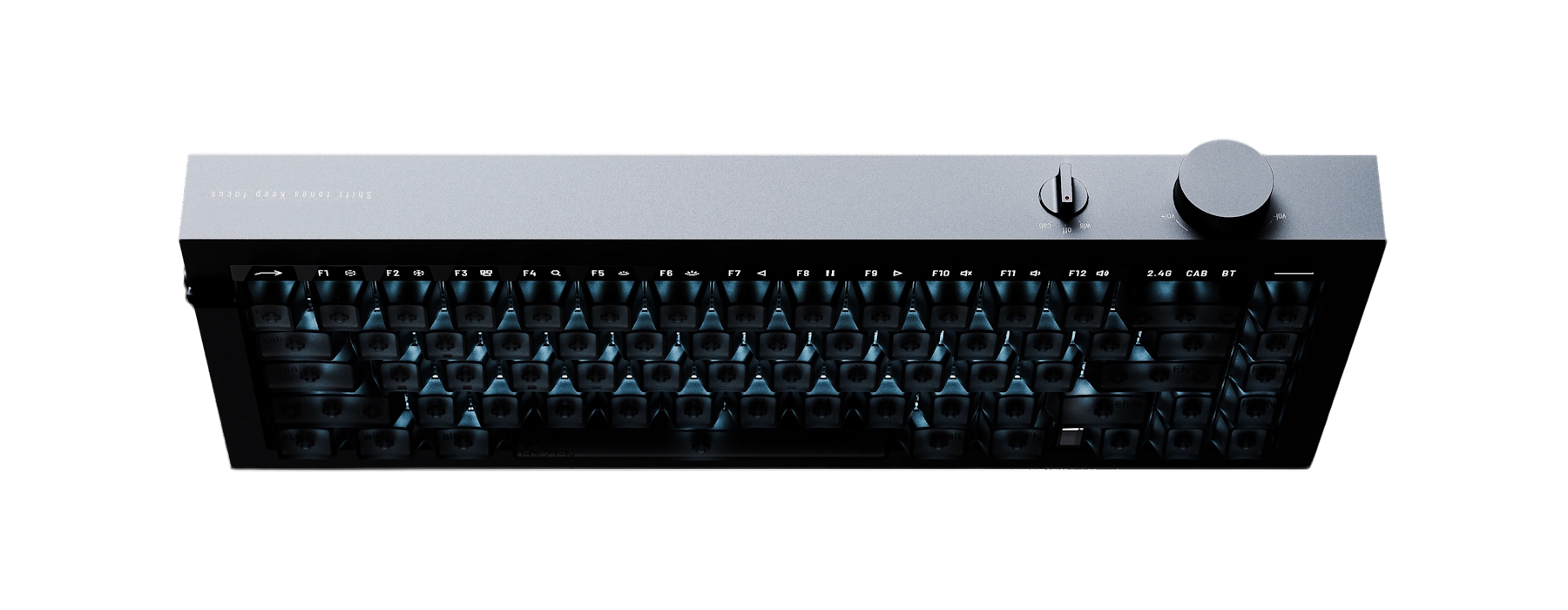
The Hybrid Switch Nobody Asked For (But Everyone Wanted)
For the last three years the keyboard discourse has split into two camps. On one side: the magnetic Hall Effect crowd — Wooting, SteelSeries Apex Pro, the entire competitive FPS shelf — chasing rapid trigger, adjustable actuation, sub-millisecond latency. On the other side: the mechanical purists — Holy Pandas, Box Jades, Cherry MX Black Hyperglides — chasing thock, smoothness, and that elusive typing feel that no linear magnetic switch has ever delivered.
Lofree's Hyzen, which dropped on Kickstarter on April 23, is the first serious attempt to refuse that choice. Co-developed with Kailh, the Nexus switch keeps the metal leaves of a traditional mechanical switch — the bit that gives you the tactile bump and the actual mechanical sound signature — and bolts a TMR magnetic sensor underneath the slider. You get the analog input behavior of a Hall Effect board AND the typing feel of a real mech. On paper this is the most interesting switch architecture since optical landed on consumer boards.
TMR vs Hall Effect: Why 0.01mm Matters
Here's the spec that made me sit up. Hyzen's Nexus switches advertise 0.01mm actuation adjustability. The current Hall Effect kings sit at 0.1mm — already finer than anyone's fingers can really exploit, but a real number you can reason about.
0.01mm is an order of magnitude tighter, and it's not marketing — TMR (Tunnel Magnetoresistance) sensors actually do exhibit higher sensitivity and a more linear voltage response than Hall sensors thanks to quantum tunneling between magnetic layers. The practical translation: you can set rapid trigger reset distances, dual-actuation triggers, and SOCD behavior with absurd precision. Whether your fingers can hit a 0.01mm reset window consistently is another question entirely. They cannot. But the headroom is there for the firmware to do clever things with it.
Polling, Latency, and the Nordic 54
The Hyzen runs on the Nordic 54-series chipset, which is the same family powering the recent wave of 8K wireless gaming peripherals. Lofree quotes a true 8,000Hz polling rate over 2.4GHz wireless, with end-to-end input latency of 0.125ms. That's parity with the wired flagships and well past the point where it matters for any human reflex, but if you're the kind of person who runs `interception-tools` to graph polling intervals, you'll appreciate that the wireless path isn't compromised.
For reference: a stock 1000Hz mechanical board sits around 1ms scan latency on top of whatever debounce delay the firmware is running. The Wooting 80HE pushed wired 8K polling into the mainstream. Razer's HyperPolling did it in mass-market gaming gear. Hyzen does it wireless, on a board with a 10,000mAh battery rated for 80 hours of operation. That battery is genuinely huge — most 8K wireless mice are bragging about 20-hour runtimes.
The Build: CNC Aluminum, Side Knob, F-Row Trick
The chassis is CNC-machined aluminum with a 12-degree typing angle, which is more aggressive than the typical 6-7 degrees on most customs. I'm reserving judgment until I can plant my wrists on it, but the optional matching palm rest suggests Lofree knows the geometry needs help.
The killer feature for productivity nerds: a physical side knob with LED indicators that reassigns the number row to function as F1-F12. No layer key, no Fn-shift gymnastics — you twist the knob and the top row's job changes. This is the kind of thing the GB community has been hacking together with QMK macros for years, and Lofree just made it a hardware affordance.
It's worth noting Lofree positioned this product upmarket. The Kickstarter early-bird tiers land at $169 for the single-mode wired version and $189 for the tri-mode wireless (Bluetooth + 2.4GHz + USB-C). Without the VIP reservation discount you're looking at $179/$199, and the projected post-campaign retail is $299. That's Keychron Q-series money on the wired side and full custom keyboard money for the wireless.
What I'm Watching For
Three open questions before I'd back this. First: stabilizers. A board with this much engineering investment in the switches is going to sound terrible if the stabs ship rattly, and Lofree hasn't shown detailed photos of the stab housing yet. Second: the actual sound profile of the Nexus switch. "Mechanical feedback" is doing a lot of work in the marketing copy, and I want to hear a sound test on a tape-modded board before I believe the thock claim. Third: VIA/QMK support. Magnetic boards have historically been stuck with proprietary software (Wootility being the lone bright spot), and a $299 wireless board that can't be remapped through open tooling is a hard sell to the community.
If Lofree nails the typing feel and ships open firmware, this is the most interesting keyboard launch of 2026. If the Nexus switch ends up sounding like a flat linear with extra steps, it's a $299 novelty. Kickstarter ships are projected for later this year — I'll have a hands-on as soon as a unit shows up.
Loading comments...