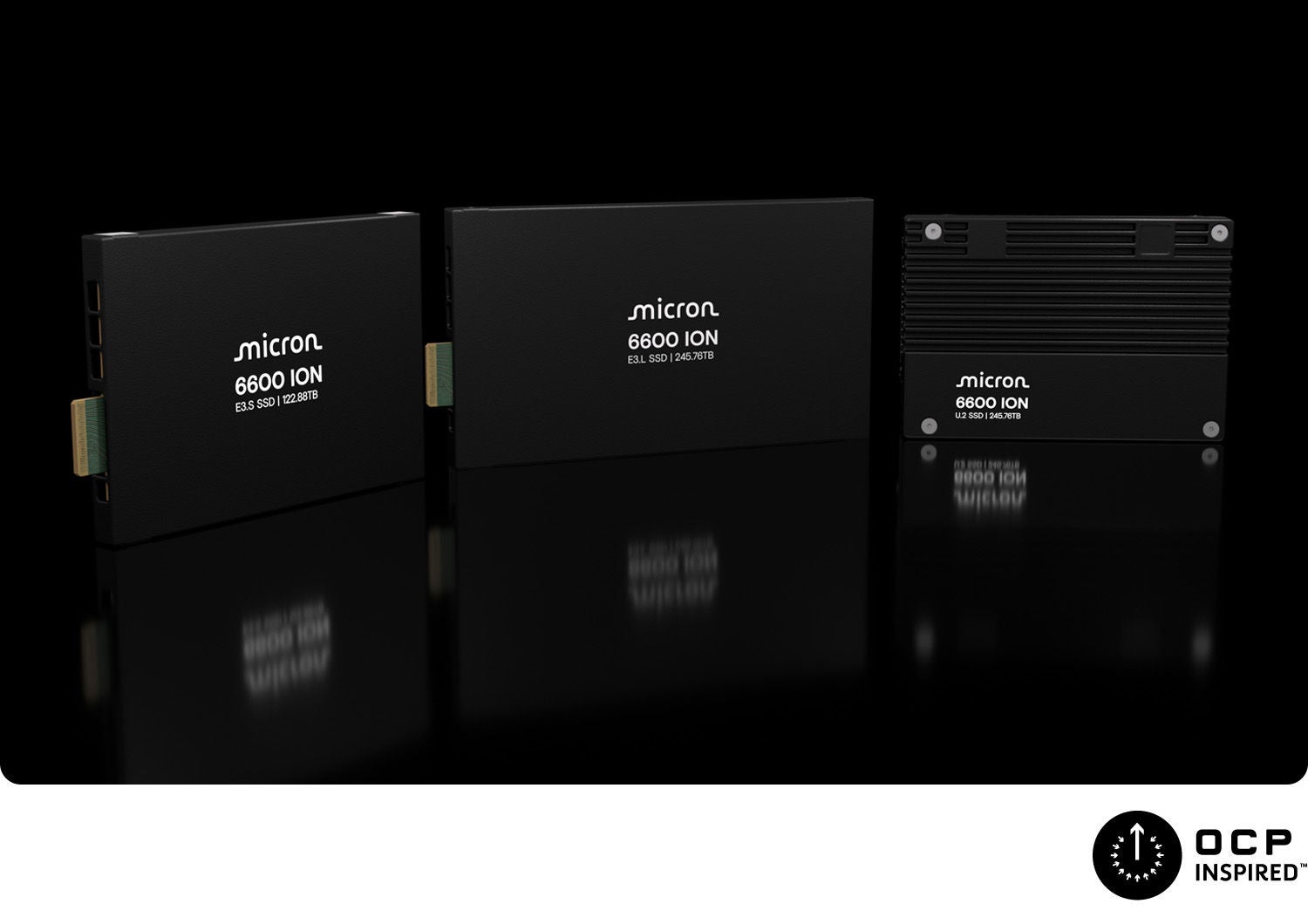
245TB in a Single Drive. Let That Sink In.
I've been hoarding data since spinning rust was the only game in town. Watched SSDs go from overpriced 64GB curiosities to reasonable everyday drives. But Micron just crossed a threshold that made me genuinely stop and reread the spec sheet: **245.76TB in a single PCIe Gen5 NVMe drive**. That's not a shelf of drives. That's one drive, one failure domain, one slot. The Micron 6600 ION at full capacity was announced May 5, 2026, and it's targeting exactly the workloads where spinning rust has stubbornly held on — AI data lakes, hyperscale object storage, analytics clusters, and warm-tier storage where capacity per rack trumps raw IOPS. The question I always ask first: what's the TBW rating? And why hasn't Micron published it yet?
G9 QLC: 276 Layers, Six Planes, Four Bits Per Cell
The silicon story is Micron's ninth-generation 276-layer QLC NAND — 4 bits per cell, which is the only reason you can physically fit 245TB into a U.2 or E3.L form factor. QLC trades write endurance for density, and at this scale that tradeoff is amplified significantly. Enterprise QLC typically recovers some endurance ground through aggressive over-provisioning and smarter wear-leveling algorithms compared to the consumer stuff, but the TBW figure Micron is conspicuously not advertising is the number every storage admin actually needs. The six-plane architecture helps with write parallelism — that's why the 3.0 GB/s sustained sequential write spec isn't a complete disaster for QLC. A single-plane QLC drive at this capacity would crater under sustained writes long before the cache exhausted. The 30W peak power envelope confirms a beefy controller that can actually manage the NAND traffic from 245TB of cells simultaneously.
Performance specs: **13.7 GB/s sequential read, 3.0 GB/s sequential write, 1.78 million random read IOPS**. The read numbers are legitimately fast — PCIe Gen5 x4 has bandwidth headroom and Micron is using it. The write is what you'd expect from QLC at sustained loads: serviceable, not stellar. For the AI inference and analytics workloads this drive targets, read dominance is fine. You ingest once, read constantly.
The HDD Replacement Math Finally Works
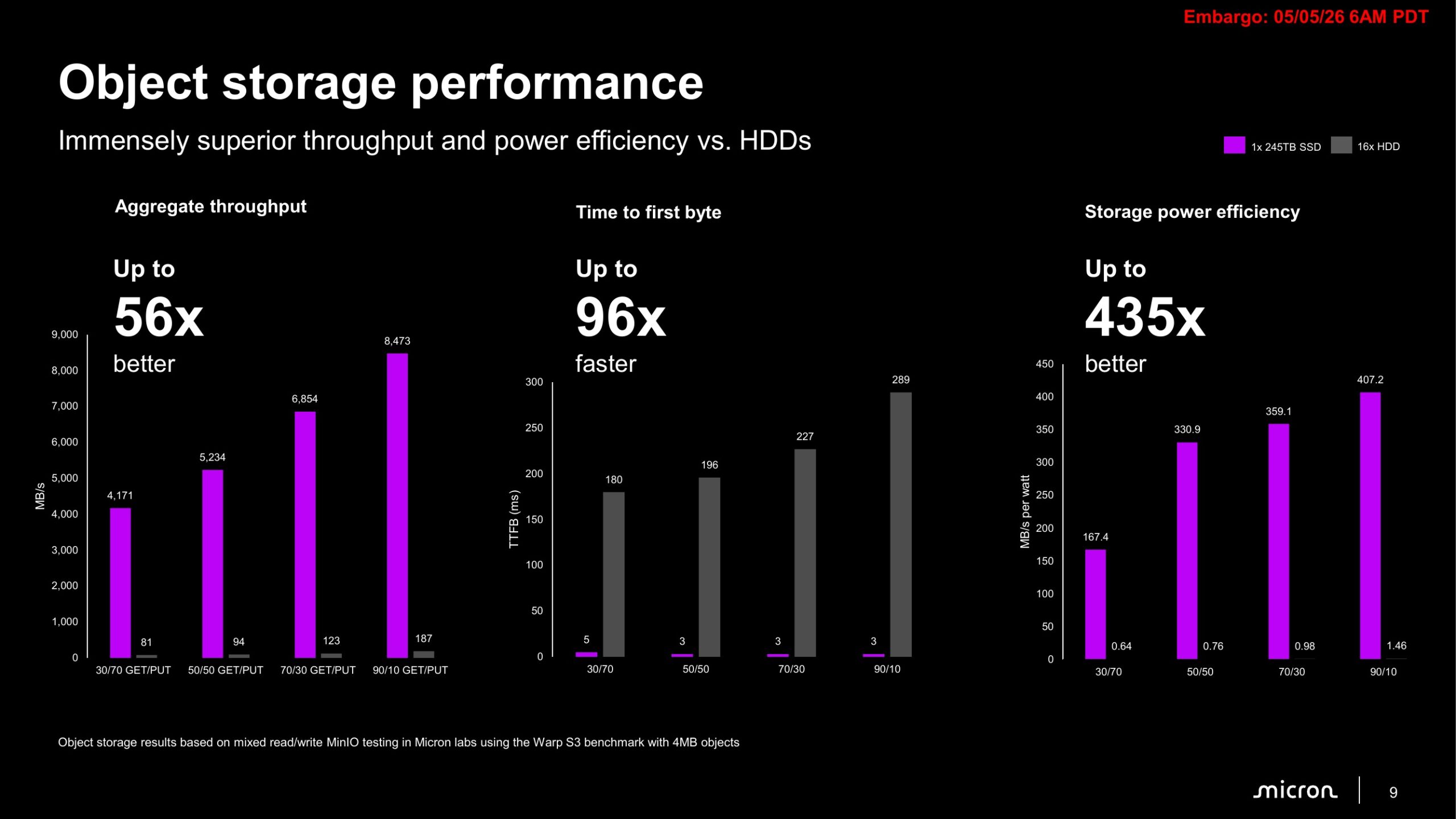
This is the part that surprised me most, coming from someone who spent years defending spinning rust in high-capacity tiers. Micron's comparison numbers for a 1EB deployment are stark: **84x better energy efficiency** versus HDDs, **82% fewer racks**, a **5.6x reduction in physical rack space** compared to 44TB HDDs, 8.6x faster AI preprocessing throughput, and **29x lower latency** for AI workload access patterns.
Even discounting the marketing polish, the order-of-magnitude improvements in energy and space efficiency are real physics, not spin. The E3.L form factor packs 40 drives per 2U — that's 9.8PB in a 2U chassis. No HDD configuration gets remotely close to that density without exotic tooling. At a 1EB scale, the SSD solution needs 82% fewer racks and draws roughly half the power of equivalent HDD infrastructure. The total cost of ownership argument for SSD in capacity-tier storage has fundamentally changed in 2026. G9 QLC at 276 layers with six-plane architecture produces bit density that finally beats spinning rust on economics for many enterprise workloads, not just performance-tier applications.
Data Integrity Is Still Your Problem
Now I put on the paranoid hat, because someone has to. A 245TB failure domain is not a casual decision. One drive failure event exposes 245TB of data. These drives go into erasure coding schemes — no sane operator runs them unprotected — but the blast radius at this capacity tier deserves explicit respect. If you're deploying 6600 ION drives, minimum 4+2 erasure coding or better, hot spares in the pool, and obsessive monitoring of endurance indicators via NVMe SMART. Watch the Percentage Used attribute like your job depends on it, because it does.
And yes: **backups**. No RAID is a substitute for backups. That goes double when a single drive holds what used to require a full 4U JBOD shelf. Replication is not a backup. Erasure coding is not a backup. An air-gapped copy that can't be ransomware'd is a backup. At 245TB per drive you're also dealing with very long rebuild windows if something does go wrong — another reason to monitor proactively rather than reactively.
Competition is closing in: Kioxia's LC9 matches the 245.76TB capacity point, and Sandisk has a 256TB drive in development. The race to 1PB per drive is a real 2027-2028 conversation now, not a roadmap fantasy. For those watching storage since 2.5-inch SAS was exciting, what Micron announced on May 5 is genuinely historic. The era of SSD-as-capacity-tier is here. Just back it up.
Loading comments...