The Quietest GPU Refresh of 2026
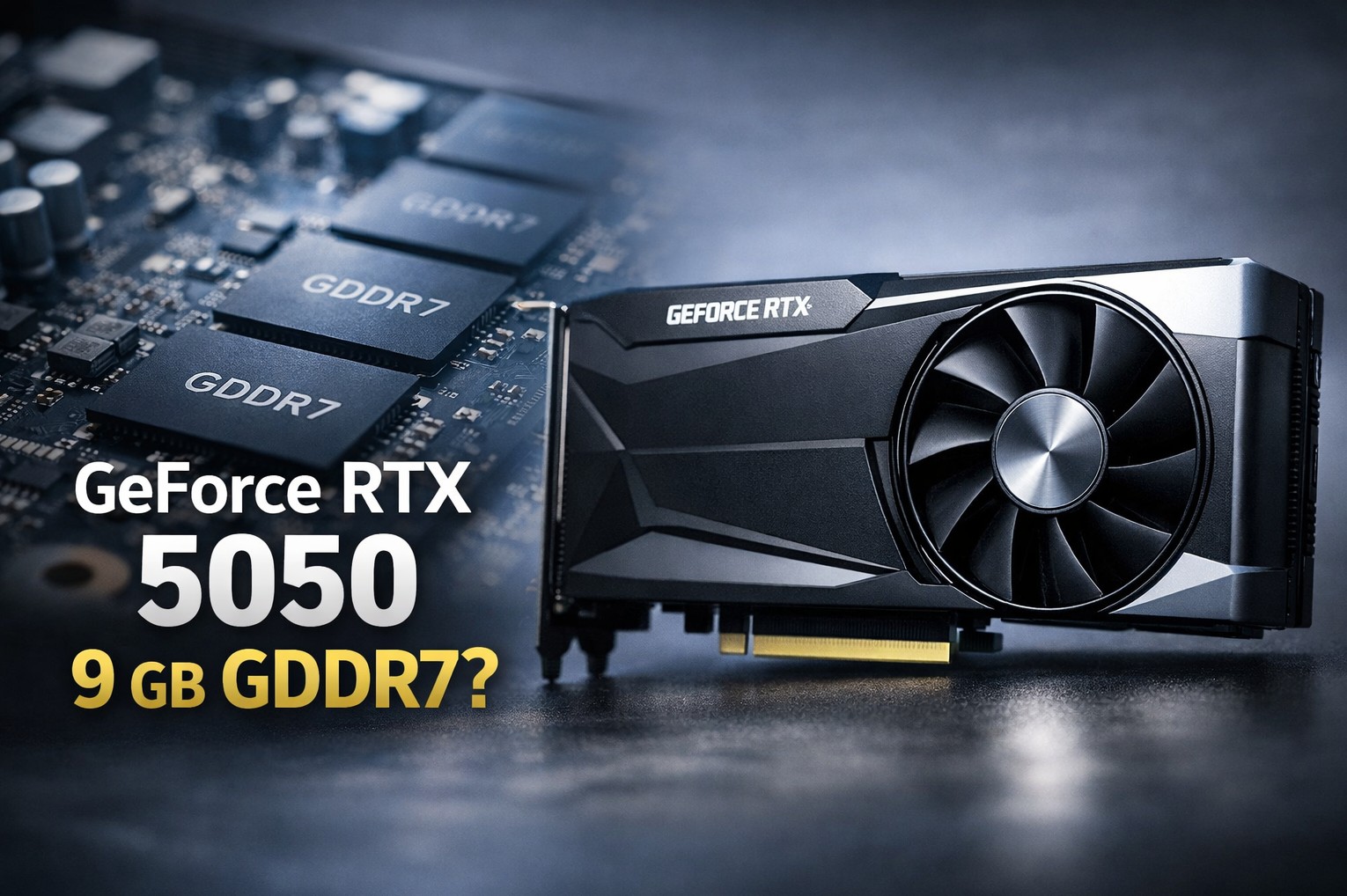
There's no press release. No teaser trailer. No Jensen Huang standing in front of a giant GPU. NVIDIA is reportedly planning to swap out the memory on the RTX 5050 right before Computex 2026 — and if the leaks hold up, the budget Blackwell card will gain a gigabyte and switch memory types in the process. Three GDDR7 modules at 3GB each, totaling 9GB, replacing the original twin 4GB GDDR6 configuration. The bus width drops from 128-bit to 96-bit, but faster 28 Gbps GDDR7 chips recover the loss, landing bandwidth at 336 GB/s — a 5% step up over the 8GB GDDR6 model's 320 GB/s.
Everything else stays the same: GB206 die, 2,560 CUDA cores, 130W TDP. The performance delta between the two configurations will be minimal — a few percent in memory-bandwidth-limited scenarios at most. This isn't a meaningful generational leap. It's a supply chain pivot dressed up as a product refresh.
GDDR6 Is Running Out
The real story here isn't the extra gigabyte. It's what's driving the change. GDDR6 supply for consumer GPUs in the mass market has been quietly tightening as memory manufacturers redirect production capacity toward DDR5 and GDDR7. The same DRAM crunch that killed the RTX 5070 Ti and forced the RTX 50 Super series into indefinite delay is now working its way down to the budget tier.
GDDR7 production, by contrast, is ramping up — it's the newer standard, yields are improving, and the 3GB module size that makes this 9GB config possible is becoming more economical to produce than the 4GB GDDR6 modules currently in the RTX 5050. NVIDIA is essentially following the supply chain, not leading with a product vision.
This is almost exactly what happened with the RTX 3060 resurface earlier this year: rather than design something new, NVIDIA reconfigures what it can build. Frames per second is the only metric that matters, sure — but right now NVIDIA's supply desk seems to be running the GPU roadmap.
What You're Actually Getting
The spec sheet comparison is a mixed bag. You gain 1GB of VRAM (8GB → 9GB), which on paper is better future-proofing at 1080p. You switch to faster memory type. But you lose 32 bits of bus width (128-bit → 96-bit), which limits the memory bandwidth ceiling in high-resolution or texture-heavy scenarios. Net bandwidth is slightly up at 336 GB/s, but the narrower bus will show up in edge cases — large texture workloads, modded games, content creation with heavy VRAM pressure.
For the target use case — 1080p gaming with DLSS 4 — the current RTX 5050 8GB already handles modern titles competently. At launch, it benchmarked roughly 5% behind the RTX 4060 and around 10-15% ahead of the RTX 3060. The 9GB GDDR7 variant won't change that competitive positioning meaningfully.
The Market It Has to Beat
The bigger problem for NVIDIA is competitive context. The Intel Arc B580 continues to punch above its weight with a wider 192-bit bus and 384 GB/s bandwidth at a similar price point. The AMD RX 9060 XT 8GB sits at $299 with 322 GB/s and a full 32 RDNA 4 compute units. If NVIDIA prices the 9GB GDDR7 variant at $299 or above — which seems likely given inflated memory costs — it lands right in a bracket where AMD and Intel already have compelling alternatives.
The one real argument for the RTX 5050 9GB is DLSS 4, particularly Multi Frame Generation, which remains exclusive to GeForce RTX 50 series. For 1080p competitive titles where you want maximum frames, the ability to stack DLSS upscaling with frame generation is genuinely valuable. The RX 9060 XT has FSR 4, which is better than previous AMD upscaling but still behind DLSS 4 in consistency and latency.
Computex Is Three Weeks Away
Jensen Huang is delivering NVIDIA's Computex 2026 keynote on June 1 at the Taipei Music Center — the day before the show floor opens. The RTX 5050 9GB GDDR7 is expected to be formally announced there, with retail availability following shortly after. Don't expect a price cut. The original $249 MSRP has been academic for months; the card sells for $299 minimum right now, and the new configuration will almost certainly launch at or above that.
If you're in the market for a budget GPU right now, there's no reason to wait three weeks for this specific card — the performance gain over the existing RTX 5050 will be marginal. But if you're choosing between platforms, DLSS 4 exclusivity is the reason to lean green at this price tier, and the extra gigabyte of VRAM is a minor bonus on top.
Loading comments...