PCIe Gen6 Is Officially Real, and It's a Samsung Part
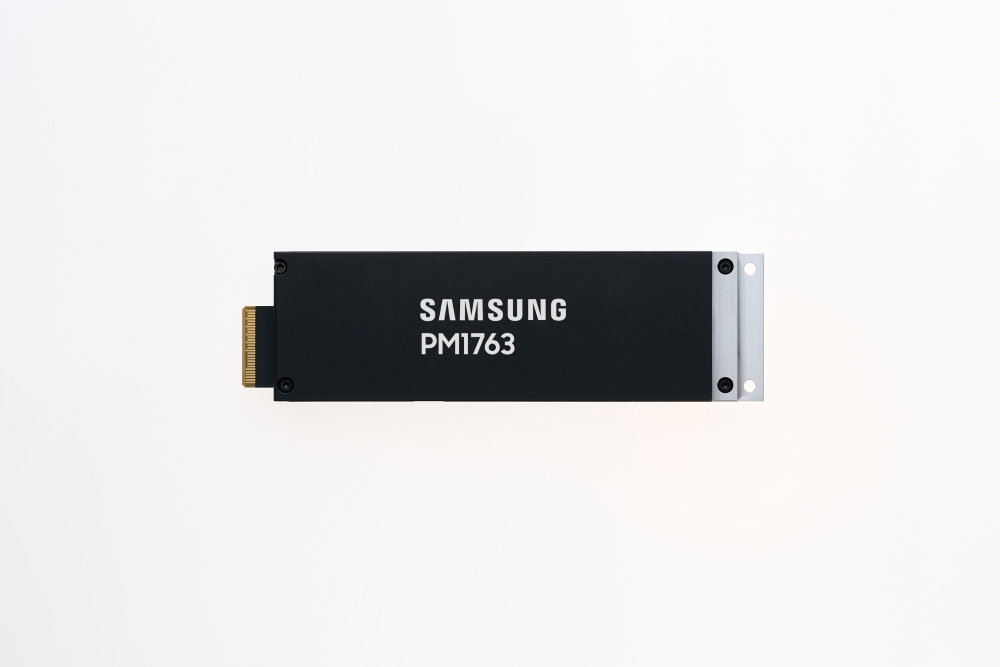
Samsung announced on July 8 that the PM1763 has entered mass production. This is the first PCIe Gen6 enterprise SSD to ship in volume — not a controller demo, not an engineering sample glued to a Vera Rubin reference platform, actual production silicon going into E3.S drives. Sequential reads are quoted at 28,400 MB/s, sequential writes at 21,900 MB/s on the 16TB SKU, and Samsung is very keen on the marketing line that this thing can push a 40GB LLM into a GPU in 1.4 seconds.
That's real, and the underlying stack is more interesting than the hero number.
What's Inside: 9th-Gen V-NAND and a 4nm Controller
The PM1763 pairs Samsung's 9th-generation V-NAND — which is the ~280-layer TLC part Samsung has been shipping in enterprise designs since late 2024 — with a brand-new 4nm controller. That controller is the actual news here. Enterprise SSD controllers have historically lagged their consumer cousins on process node (SM2508 shipped on 6nm; Marvell's Bravera family sat on 12nm forever), because DWPD-optimized firmware and power-envelope work matter more than transistor density for nearline workloads. Samsung going straight to a 4nm controller is a signal that PCIe 6.0's 63 GT/s per lane is genuinely thermally hostile, and you need every joule you can save just to keep the PHY from cooking itself.
Capacities are 4TB, 8TB, and 16TB in E3.S. No U.2, no U.3, no M.2. Samsung is telling you exactly which market this is for: liquid-cooled AI training racks. And E3.S is the correct form factor for that — better airflow, better hot-swap ergonomics, better power delivery than U.2's aging connector.
Security Features Nobody Will Talk About in the Marketing Deck
Buried in the spec sheet are two things I actually care about more than the 28 GB/s number: post-quantum crypto support and TDISP (TEE Device Interface Security Protocol). Post-quantum matters because any data you write to this drive today needs to still be encrypted-at-rest in 15 years when CRYSTALS-Kyber replaces every RSA key in the data center. TDISP matters because it's the plumbing that lets a confidential-compute VM trust that the SSD it's talking to hasn't been swapped out by a hostile hypervisor. Both features are enterprise-only for now, but they'll trickle down. Consumer NVMe drives with hardware post-quantum are probably a 2028 story.
What Samsung Isn't Telling You: The Endurance Rating
Here's where I start twitching. Samsung's press release, the ServeTheHome writeup, the TechPowerUp piece — none of them list a DWPD figure. None of them list a TBW figure. Not one. For an enterprise drive being sold into AI training workloads, that's not an oversight. That's a deliberate omission.
The previous-gen PM1753 was rated at 1 DWPD for read-intensive SKUs and 3 DWPD for mixed-use. The PM9A3 before it was 1 DWPD across the board. If Samsung had a 3 DWPD number on the PM1763, they would have printed it in 96-point font. The fact that they haven't tells me one of two things is going on: either the endurance rating is still being characterized because 9th-gen V-NAND on a brand-new 4nm controller with Gen6 PHY thermals is a lot of new variables at once, or the number is going to be conservative and Samsung is delaying the disclosure until customers have committed to design wins.
Either way, do not — I repeat, do not — treat this drive as a checkpoint target for a training run until you have that number in a datasheet with Samsung's stamp on it. AI training workloads chew through DWPD like nothing else. A misjudged endurance envelope on a 16TB drive at $3,000+ per unit is a very expensive lesson.
The Bigger Picture: Gen6 Consumer Drives Are Still Two Years Away
Silicon Motion's SVP Nelson Duann told Tom's Hardware last month that consumer Gen6 controllers won't land until 2027, and that's assuming NAND allocation doesn't fall off a cliff. Between now and then, the PM1763 and whatever Micron and SK hynix ship in response will consume the entire Gen6 NAND allocation. Any 3D NAND wafer that could have gone into a consumer QLC drive is instead going into 16TB E3.S enterprise units at four to five times the margin.
So if you're building out a homelab and eyeing Gen6 for a future NAS refresh: don't. You have plenty of time. Buy Gen4 U.2 enterprise pulls on eBay, run them in mirrors, and back everything up to spinning rust. No RAID is a substitute for backups, and no Gen6 marketing slide is a substitute for a datasheet with a DWPD number on it.
Loading comments...