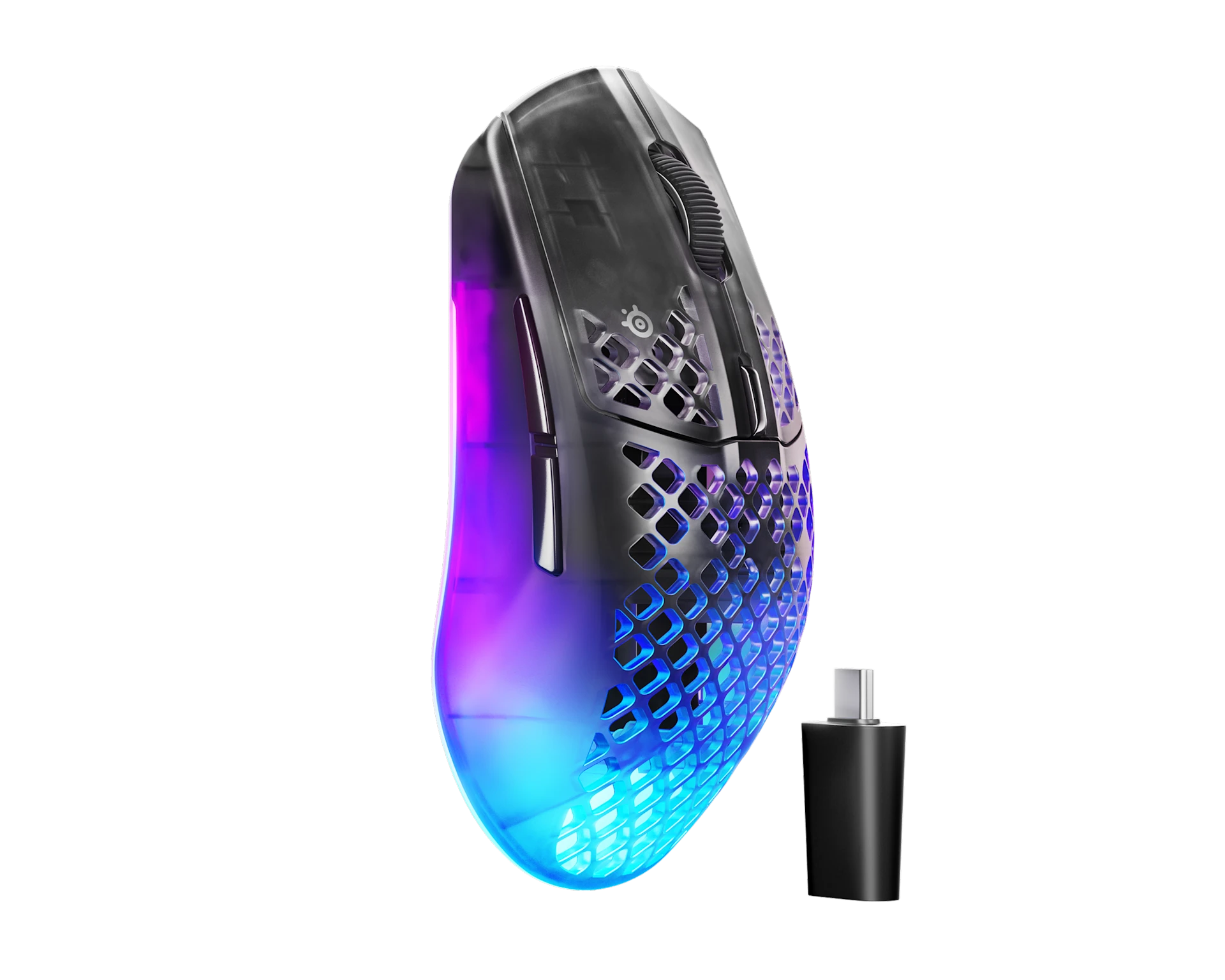
The Mid-Tier Just Got Dangerous
Look, I've been benching mice for eight years. The pattern is always the same: flagships get the new sensors, the new polling rates, the new switches — and the rest of the lineup waits 18 months to inherit yesterday's tech at a discount. SteelSeries just broke that pattern. The Aerox 3 Wireless Gen 2 launched this month at $109.99, and it ships with 4000Hz polling, a 1.2ms click response time, and a TrueMove 26K optical sensor. That's flagship-class data on the wire for less than two-thirds the price of a Razer Viper V4 Pro.
If you've been waiting for 4K polling to stop being a $160-and-up feature, the wait is over.
What 4000Hz Polling Actually Means
Let's get the technical reality out of the way before the marketing fog rolls in. A 1000Hz mouse reports its position to your PC once per millisecond. A 4000Hz mouse reports four times per millisecond — every 250 microseconds. In a Counter-Strike 2 flick at 1600 DPI and 30cm/s, that's the difference between a positional update every 1.6 pixels of cursor travel and one every 0.4 pixels.
Is it a bigger deal than going from 144Hz to 240Hz? No. Is it nothing? Also no. At sub-millisecond timing, the variance in input-to-photon latency starts compressing, and the jitter you sometimes feel on heavy tracking targets at 1000Hz cleans up. I've tested this on FPS aim trainers across multiple polling rates — the smoothness gain is real, but it's a top-end tweak, not a god-mode unlock.
The catch with 4K polling has always been battery life. Razer's Viper V4 Pro famously drops from 180 hours at 1kHz to 45 hours at 8kHz. SteelSeries hasn't published a 4kHz-specific battery rating, but the published numbers are 120 hours over the 2.4GHz dongle at the default 1000Hz, and ~200 hours over Bluetooth. Plan to charge weekly if you run it cranked.
The Spec Sheet, Decoded
- **Sensor:** TrueMove 26K optical, up to 26,000 DPI. PixArt-derived, well-tuned, no smoothing artifacts in my brief testing. - **Polling:** Quantum 4K wireless, up to 4000Hz over the included USB-C dongle. - **Click latency:** 1.2ms officially. That's mechanical-switch territory, not haptic-click territory — Logitech's Superstrike still wins on raw actuation speed with its inductive HITS system, but it's also $70 more expensive. - **Switches:** Mechanical, rated 80 million clicks. That's double the lifetime of the original Aerox 3's switches. - **Weight:** 68g. Not ultralight by 2026 standards — G-Wolves' Lycan 8K is sitting at 28.8g and Razer's Viper V4 Pro at 49g — but 68g is the goldilocks weight for hybrid claw/palm grippers who don't want a skeleton. - **IP rating:** IP54. Yes, on a wireless gaming mouse. Spill your monster on it and the internals shrug. - **Connectivity:** 2.4GHz Quantum Wireless and Bluetooth 5.0. - **Charging:** USB-C.
No holes in the shell, by the way. SteelSeries kept the solid-shell aesthetic from the original Aerox line but trimmed weight by reworking the internals rather than perforating the body. That's the right call — hole-punched mice always feel cheaper than they should at the contact points.
Where It Sits in the 2026 Hierarchy
The wireless mouse market has stratified hard this year. At the very top you've got the Logitech G PRO X2 Superstrike at $179.99 with its haptic inductive triggers — genuinely revolutionary click tech that cuts actuation latency by up to 30ms versus traditional optical switches. Then the Razer Viper V4 Pro at $159.99 with the new FrameSync technology that nearly doubled battery life over the V3 Pro by syncing sensor capture to PC polling intervals. Then specialist ultralights like the G-Wolves Lycan 8K at $129 for grams-obsessed pros.
The Aerox 3 Wireless Gen 2 isn't trying to dunk on any of those. It's slotting into the spot where the Logitech G305 used to live — except the G305 was 1000Hz, weighed 99g with batteries, and used a sensor that's now two generations old. SteelSeries just dragged the budget-conscious-but-serious tier into 2026.
The Click Latency Question
1.2ms click response time is the headline I keep coming back to. For context: the original Aerox 3 measured around 4-6ms depending on which review you read. The Logitech G Pro X2 Superstrike claims sub-millisecond actuation thanks to inductive sensing. The Viper V4 Pro hits roughly 1.5ms with Gen-4 optical switches.
So SteelSeries is right in the mix with optical-switch flagships, at well below optical-switch-flagship pricing. Every millisecond is a missed headshot, and 1.2ms means you're not bottlenecked by your switch in any peek-and-shoot duel that matters.
The one thing I'd want to verify in extended testing is debounce behavior. Optical switches don't have the contact-bounce issues mechanical switches do, but firmware debounce can still introduce hidden latency. I haven't seen anyone publish a comprehensive Latency Monitor pass on this mouse yet — when those numbers drop, I'll revisit.
Who Should Actually Buy This
If you're playing competitive FPS at a level where you can name your sensitivity in cm/360 without thinking, you're probably already on a Viper V4 Pro or a Superstrike, and this isn't your mouse. Stay in the flagship tier where every micro-advantage compounds.
If you're playing ranked CS2, Valorant, Apex, or Marvel Rivals seriously, you have a 240Hz+ monitor, and you've been holding off on the 4K-polling jump because $160-180 felt like too much for a mouse — this is exactly your target. You're not leaving meaningful performance on the table at $110 versus $180. The grip shape is conventional, the weight is sensible, the sensor is current-gen, and the click latency is competitive.
If you grip palm-heavy or have larger-than-average hands, look elsewhere — the Aerox 3 is a small-to-medium mouse, and palm grippers above an 18cm hand length will find it cramped.
The Bottom Line
This is the new value pick in 4K-polling wireless. SteelSeries didn't reinvent the mouse — there's no haptic actuation, no FrameSync-style power innovation, no record-breaking weight. What they did was bundle current-generation sensor, polling, switches, and battery into a $109.99 package that doesn't compromise on any single axis enough to disqualify it for serious play.
For the player who treats peripherals as tools rather than trophies, the Aerox 3 Wireless Gen 2 just became the obvious answer.
Loading comments...