The Voltage Tax on Fast DDR5
If you've been spec-hunting DDR5-8000 kits, you already know the dirty secret: most of them require 1.4V or higher to hit those speeds, and that means XMP or EXPO profiles — proprietary overclocking specs that push modules well beyond JEDEC-spec operation. That's fine until it isn't. Elevated voltage increases heat and cell wear over long runtimes, and in sustained workloads — 24/7 workstations, rendering farms, anything running non-stop for months — it's a real longevity concern. Most enthusiast RAM reviews skip this entirely because they test a kit for a week and move on.
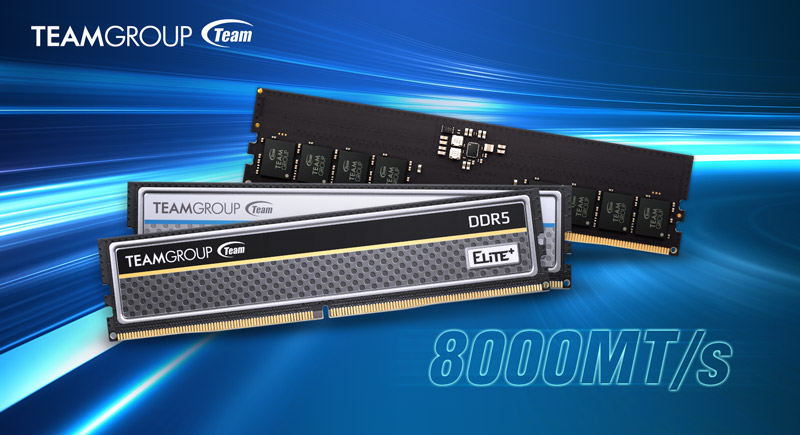
TeamGroup just announced something worth paying attention to: the ELITE PLUS DDR5 and ELITE DDR5 in 8000 MT/s spec, running at just 1.1V with CL56-56-56-128 timings. That's JEDEC-compliant voltage at DDR5-8000 speeds. The modules use DDR5 Same-Bank Refresh (SBRX) technology and what TeamGroup calls an "optimized IC architecture" to achieve it — no XMP, no EXPO, no voltage slider required.
What 1.1V at DDR5-8000 Actually Means
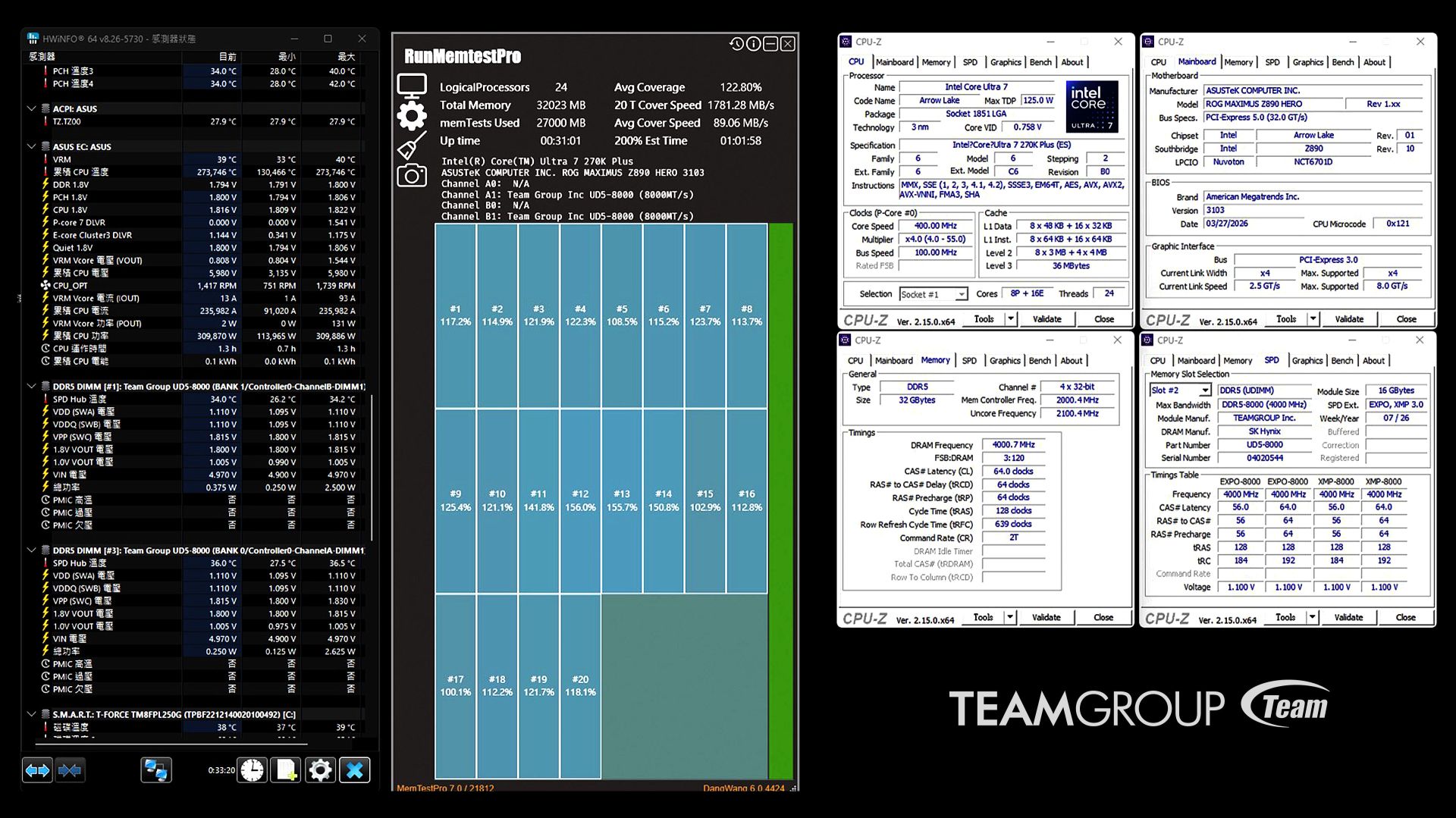
Standard DDR5 JEDEC spec tops out at DDR5-6400 at 1.1V. Getting to 8000 MT/s on most competitor kits means pushing voltage to 1.35–1.45V via XMP 3.0 or EXPO. TeamGroup is claiming their ICs are binned tightly enough to hit 8000 MT/s natively at stock voltage. SBRX is the key enabler here — it refreshes memory banks more efficiently than traditional row refresh cycles, reducing overhead and keeping data integrity intact at higher transfer rates. Combined with careful IC selection, the result is a kit that shouldn't require any manual tuning to run at rated speed.
CL56-56-56-128 are the timings, which are not tight. DDR5-6000 CL30 kits have lower absolute latency — if you're chasing minimum ping in esports titles, this is the wrong product. But for bandwidth-hungry applications moving large sequential blocks — video editing, data compression, large dataset processing, ZFS ARC — raw MT/s wins over tight latency. The workloads where 8000 MT/s actually matters are also the workloads where stability and longevity matter most.
Platform Support: Z890 and X870E
Compatibility is confirmed for Intel Z890 (Arrow Lake) and AMD X870E (Ryzen 9000) platforms. JEDEC compliance means no wrestling with XMP profiles — install it, POST, and it runs at rated speed. For always-on workstations where uptime matters, that removes an entire category of potential instability.
This point is underappreciated: a non-trivial number of subtle data corruption incidents trace back to memory running marginally stable XMP profiles on boards with poor training algorithms. The system appears stable, memtest passes, and then weeks later you find a corrupted file. JEDEC-native operation removes that variable entirely. DDR5 also includes on-die ECC (ODECC) at the IC level — it corrects single-bit errors before they reach the memory controller. Not a replacement for registered ECC in a server context, but it's a real layer of protection that DDR4 didn't have. Stable voltage plus ODECC is the right foundation.
The Market Reality
No pricing has been announced for the 16GB×2 (32GB) kits. Given the ongoing DDR5 shortage driven by AI datacenter demand — the same supply crunch that pushed 32GB DDR5-6000 kits from roughly $90 late last year to nearly $285 today — expect a premium. DDR5-8000 at 1.1V requires binned ICs, and binned ICs cost more in a tight supply environment. The modules are slated for Amazon North America availability in June 2026. Given how quickly fast DDR5 stock evaporates right now, set a price alert the day they list.
The Takeaway
Most of the DDR5-8000 market is built on voltage headroom. TeamGroup is attempting to get there through better IC binning and the SBRX architecture instead. If the modules deliver on that spec in practice — and platform-wide JEDEC compatibility is a strong signal that they will — this is the right approach for anyone who runs a machine continuously rather than just benchmarking it. No RAID is a substitute for backups, but stable memory is where data integrity starts.
Loading comments...